


Quick picks and choosing your mono-red deck
Start with a deck plan
Best Mono-Red Commanders at a Glance
| Theme | First recommendation | Closest alternative |
|---|---|---|
| Goblins | Krenko, Mob Boss | Tin Street Kingpin for attacking; Pashalik for death triggers. |
| Treasure and Dwarves | Magda, Brazen Outlaw | The Hoardmaster for crimes and Dragon tokens instead of a tutor. |
| Burn | Solphim, Mayhem Dominus | Axonil for small red pings; Torbran for red combat as well. |
| Targeted spells | Zada, Hedron Grinder | Rosnakht makes bodies; Zada can turn an existing army into cards. |
| Spell chains | Birgi, God of Storytelling | Ashling for copies and filtering; Urabrask for instants and sorceries. |
| Creature-entry damage | Purphoros, God of the Forge | Norin for repeated returns; Zurzoth for a Devil engine. |
| Artifacts | Daretti, Scrap Savant | Chiss-Goria for attacking and casting; Kurkesh for activated abilities. |
| Creature copies | Kiki-Jiki, Mirror Breaker | Rionya for spell-supported bursts; Feldon for graveyard targets. |
| Dragons | Lathliss, Dragon Queen | Sarkhan for a cheaper start; Zirilan for exact temporary targets. |
| Large creatures | Purphoros, Bronze-Blooded | Herigast for emerge; Ilharg for attack-based borrowing. |
| Exile access | Laelia, the Blade Reforged | Dragonhawk for larger creatures; Rose for wider attacks. |
| Equipment | Godo, Bandit Warlord | Gilgamesh for more Equipment; Valduk for token attacks. |
| Shared combat | Alexios, Deimos of Kosmos | Slicer for lending; Kazuul for a defensive decision. |
| Damage into mana | Neheb, the Eternal | Roku and Zuko supply mana during combat instead. |
| Self-damage | Auntie Blyte, Bad Influence | Daredevil redirects damage; Ashling supplies a symmetric release. |
| Discard | Inti, Seneschal of the Sun | Ivora for Blood and a growing threat; Sabin for graveyard blitz. |
| Lands and extra combats | Moraug, Fury of Akoum | Zell for extra land permission with an end-step return. |
The whole deck
How to Choose a Mono-Red Commander
- For a first Goblin deck, start with Krenko, Mob Boss. He supplies the army; your support cards supply haste, cards and a way to finish.
- For straightforward burn, start with Solphim. Choose Ojer Axonil instead when repeated small red damage and power boosts are the point.
- For Dragons, start with Lathliss. Sarkhan offers earlier development, while Zirilan asks for a carefully chosen toolbox.
- For inexpensive creature-based spell chains, start with Zada. The list needs creatures before its targeting cantrips become a large draw engine.
- Work out what your commander gives you. Magda makes resources and finds cards. Purphoros deals damage but needs you to supply creatures. The other 99 cards have to fill those gaps.
- Price the whole deck. One color makes the mana base simpler, but premium artifacts, tutors, Equipment and franchise printings can still be expensive. An affordable commander does not guarantee an affordable list.
- Leave yourself a way to recover. You still need useful plays after a sweeper, graveyard exile or removal that makes your commander cost two more.
- Tell the other players what to expect. If your deck uses repeated land destruction, fast combos or a lethal commander passed around the table, explain that before the game.
Want to compare mono-red with other colors? Our Best Commanders in MTG guide covers the wider field. The Best Mono-White Commanders guide offers the companion theme lists.
Bracket 2, Bracket 3, Bracket 4 and cEDH
Power expectations
Mono-Red Commanders by Bracket
You can build the same commander for very different games. These suggestions are starting directions, not certifications of unseen decklists. The official bracket depends on your complete deck, how quickly it can win and what kind of game you intend to play.
| Bracket | Starting directions | What the whole list must respect |
|---|---|---|
| 2: Core | Lathliss, Dragon Queen, Krenko, Tin Street Kingpin | Straightforward, unoptimized development and combat. No Game Changers; official guidance expects at least eight turns of play. |
| 3: Upgraded | Krenko, Mob Boss, Solphim, Mayhem Dominus, Daretti, Scrap Savant | Strong synergy with at most three Game Changers. Follow restrictions on early two-card infinites, mass land denial and extra turns; official guidance expects at least six turns of play. |
| 4: Optimized | Zada, Hedron Grinder, Ashling, Flame Dancer, Magda, Brazen Outlaw | Faster mana, tutors, compact finishes and strong interaction can belong here. An optimized casual list is not automatically a tournament cEDH deck. |
| 5: cEDH | Magda, Brazen Outlaw, Godo, Bandit Warlord | Compare complete current lists and actual event results. Mono-red legality or a real infinite combo alone does not establish competitive success. |
Wizards’ current Commander overview gives the current restrictions. Check the Game Changers list and actual combo availability before a game. Merely waiting to execute an easily available early combo does not turn its deck into a Bracket 3 build.
Upgraded plans
Best Mono-Red Commanders for Bracket 3
- Krenko, Mob Boss: Goblin development, normal attacks, protection and recovery. Leave the fast tutor-and-loop package out of this version.
- Lathliss, Dragon Queen: Dragons, ramp, draw and a visible flying finish. Budget the curve rather than relying on one expensive topdeck.
- Solphim, Mayhem Dominus: Useful burn and repeatable damage with cards to sustain the plan. Damage doubling alone is not a full deck.
- Daretti, Scrap Savant: Artifact recovery with useful entry and death value. Repeated hard locks change the table fit.
- Laelia, the Blade Reforged: Exile-based card access and growing combat pressure, with mana available for the revealed cards.
- Magda, the Hoardmaster: Interaction on several turns and a hasty Dragon finish, rather than Brazen Outlaw’s exact combo tutor.
Optimized plans
Best Mono-Red Commanders for Bracket 4
- Zada, Hedron Grinder: A large creature base, cheap targeting cantrips and mana to use the drawn cards. The supporting board is a real vulnerability.
- Ashling, Flame Dancer: Dense spells and copies with deliberate second and third magecraft resolutions.
- Birgi, God of Storytelling: A cast-based mana engine, enough card access and an exact finish. A rebate is not automatically infinite.
- Magda, Brazen Outlaw: Ways to tap Dwarves efficiently and the right artifacts or Dragons to find. Tell the other players if those targets include a fast combo that wins the game.
- Godo, Bandit Warlord: Helm of the Host with enough mana to tutor, equip and begin the combat sequence.
- Neheb, the Eternal: Reliable life loss before the postcombat main phase, with spells worth spending the red mana on.
Results checked October 4, 2026
Best Mono-Red Commanders for cEDH
If you want to research a competitive mono-red deck, start with Magda, Brazen Outlaw. The checked database reports 267 entries to Godo’s 24 and includes a first-place finish at a named cEDH national event. Godo has a recorded tournament win too, but there is less evidence in its smaller sample.
| Commander | Reported entries | What we can conclude |
|---|---|---|
| Magda, Brazen Outlaw | 267 | 267 reported entries; only the first 48 event records were returned. Specific results support the recommendation, but aggregate conversion is withheld. |
| Godo, Bandit Warlord | 24 | A complete 24-entry returned sample, including a recorded tournament win. This is a smaller evidence base than Magda’s. |
| Birgi, God of Storytelling | Not verified | The filtered profile could not be verified. No current entry count or performance rate is claimed. |
| Krenko, Mob Boss | 16 | The returned sample includes a named Bracket 3 event. It is not a clean cEDH-only sample; conversion is withheld. |
| Slicer, Hired Muscle | Not verified | The filtered profile could not be verified. No current entry count or performance rate is claimed. |
| Rionya, Fire Dancer | 0 | No entries in this filtered view. That is not proof the deck is unplayed or incapable of winning. |
- Magda: cEDH Nationals Deutschland - Invitational, September 5, 2026: 64 players, recorded placing 1.
- Magda: ULTIMO Clasificatorio Nacional cEDH STACK SURFERS, August 22, 2026: 53 players, recorded placing 1.
- Godo: Mana in the Bank 2: MELEE, July 25, 2026: 105 players, recorded placing 1.
- Krenko: its sixteen-entry view includes a named Bracket 3 event. Do not turn those records into a claimed cEDH rate.
- Birgi and Slicer: strong rules-based plans or older reputations do not replace a verified current event sample. We did not verify their filtered profiles here.
- Choose a complete list: learn its winning card combinations, interaction and which opening hands to keep. Choosing the commander alone will not reproduce a tournament result.
An entry is a deck appearing at an event, not necessarily a different player. A conversion figure is not a game win rate, and we publish no aggregate conversion rates here: we could not see all of Magda’s event records, and Krenko’s sample includes a different bracket. These named finishes show what happened at those events. They do not tell you the chance that your deck will win. Follow the event links to see the recorded lists.
Beginner choices, budget and deckbuilding
Clear starting plans
Best Mono-Red Commanders for Beginners and Budget Builds
| Commander | Build plan | Cost or complexity to check |
|---|---|---|
| Krenko, Mob Boss | Make Goblins, protect the army and use combat or sacrifice damage. | Haste, draw and recovery matter; do not buy only token multipliers. |
| Lathliss, Dragon Queen | Ramp into Dragons and make more flying attackers. | An expensive creature curve still needs lands, ramp and draw. |
| Solphim, Mayhem Dominus | Cast useful burn and double opposing noncombat damage. | Keep cards coming; doubling does not create a hand of spells. |
| Laelia, the Blade Reforged | Attack and use temporary exile options. | Leave mana and a land play available; the cards are not safely in hand. |
| Zada, Hedron Grinder | Build a cheap army and copy one-creature cantrips. | The cards can be inexpensive, but targeting and chain sequencing take practice. |
These are starting deck plans, not priced shopping lists. A cheap copy of the commander can still lead to an expensive deck. Compare the whole list and available printings, including condition and shipping, before deciding what you can afford.
Useful support
Mono-Red Commander Draw, Ramp and Win Conditions
- Card access: Faithless Looting filters; Reckless Impulse provides temporary exile access. Those are different from permanently adding several cards to hand. Match the timing to the mana you can spend.
- Mana: ordinary artifact acceleration, spell rebates and temporary rituals do different jobs. Ruby Medallion reduces generic costs of red spells; Birgi makes red mana on casts. Neither removes an arbitrary colored payment.
- Interaction: Chaos Warp can answer a troublesome permanent but its replacement reveal is a real risk. Vandalblast handles opposing artifacts; creature-damage sweepers do not cover every permanent type.
- Goblin support: Skirk Prospector supplies sacrifice mana, Goblin Bombardment a damage outlet, and Skullclamp a possible card engine. Check creature toughness and your actual board before assuming the draw works.
- Dragon support: Dragon Tempest links flying entries and Dragon damage. It is a support option, not a reason to remove ramp and draw from a costly curve.
- Spell support: cantrips, rituals and copies must keep the next cast available. A copied spell that was not cast does not trigger a cast-only commander.
- Closing: wide combat, commander combat damage, burn and a deterministic combo need different support. Choose a real finish instead of accumulating Treasures or cards indefinitely.
- Protection: haste creates an earlier chance to act. It does not protect against removal, and indestructible does not stop exile or sacrifice.
Each theme starts at 1, with our starting recommendations first and more specialized choices later. The guide has 110 distinct legal cards. The numbers help you browse each theme; they do not claim all these decks are equally powerful or rank Goblins against Dragons.
Mono-red theme
Best Mono-Red Commanders for Goblins and attacking armies
Krenko, Mob Boss is our first stop for a Goblin army. The other choices change what you do with it: attack sooner, sacrifice creatures for damage or turn artifacts into more Goblins.
1. Krenko, Mob Boss
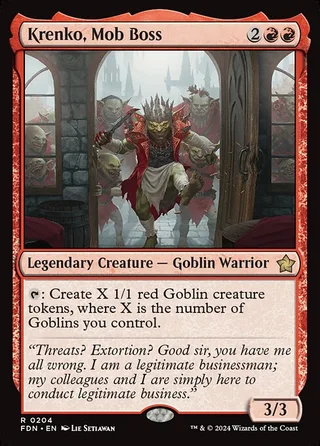
Start here if you want a lot of Goblins.
Krenko gives you the army. Tap him and you get a new Goblin for every Goblin you already control, including Krenko himself. That makes a few early creatures much more threatening once you can activate him repeatedly. Haste matters here: without it, your four-mana commander has to survive a turn before making anything.
Mob Boss is our first choice over Tin Street Kingpin when you want to grow the board through activations. Untap effects help him do that, while draw and protection help you keep playing after someone answers him. Goblin Bombardment lets those tokens deal damage when attacking won't work. Fast, tutored loops are another way to build him, but the other players should know if that's the deck you're bringing.
44,362 EDHREC decks (past two years; October 4, 2026). Oracle text and rulings. Compare singles printings and prices.
Shop Krenko, Mob Boss2. Krenko, Tin Street Kingpin
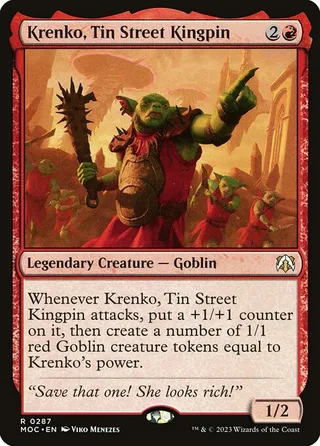
The Krenko for players who want to attack.
Tin Street Kingpin costs less than Mob Boss, but he has to attack to make Goblins. The attack trigger puts a counter on him first, then makes tokens equal to his power. Equipment and pump spells can help both halves of that plan. You get the trigger when he attacks, so a blocked Krenko can still add to your army.
This version fits a smaller, faster attacking deck. You'll want attacks he can survive, because a commander you can't safely send into combat isn't much of a token engine. A hand full of pump spells also looks a lot worse after he's removed. Mob Boss is the better starting point if you'd rather stay back and activate your commander.
1,803 EDHREC decks (past two years; October 4, 2026). Oracle text and rulings. Compare singles printings and prices.
Shop Krenko, Tin Street Kingpin3. General Kreat, the Boltbringer
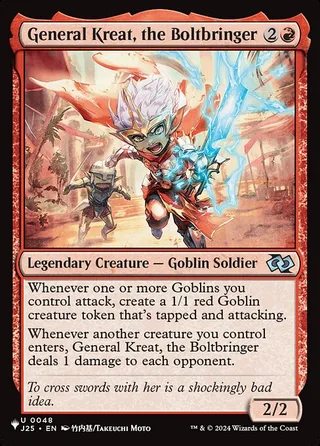
Your Goblins don't all have to connect to hurt everyone.
Kreat combines the attack plan with a reason to make more creatures. When one or more of your Goblins attack, you get one tapped-and-attacking Goblin. That's one token for the trigger, not one per attacker. Separately, your creature entries damage every opponent, so token makers can keep hurting the table even when blockers stop your attacks.
Krenko, Mob Boss grows the army faster; Kreat makes the damage payoff part of your commander. That trade makes sense if you want Goblin combat with some of Purphoros's reach. Token makers in the rest of the deck matter too. If Kreat is removed, you still want a way to put creatures on the battlefield.
2,784 EDHREC decks (past two years; October 4, 2026). Oracle text and rulings. Compare singles printings and prices.
Shop General Kreat, the Boltbringer4. Muxus, Goblin Grandee
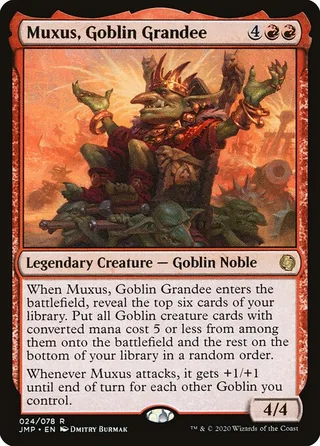
Six mana can buy you a whole new Goblin board.
Muxus looks at six cards and puts the Goblin creatures with mana value five or less straight onto the battlefield. The more Goblins you put in the deck, the more useful that reveal becomes. His attack bonus can turn the new board into a threat, but getting several creatures from one entry is the real attraction.
The catch is the six-mana price and the possibility of a poor reveal. Too many noncreature combo pieces make that more likely, even if each is powerful on its own. Ways to reuse Muxus's entry and recover after removal give the deck another chance. He shares cards with Krenko, but you're building toward a much bigger turn.
2,411 EDHREC decks (past two years; October 4, 2026). Oracle text and rulings. Compare singles printings and prices.
Shop Muxus, Goblin Grandee5. Pashalik Mons
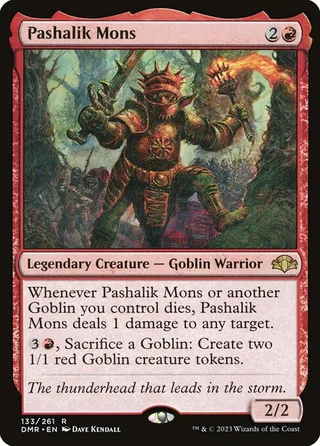
A dead Goblin can still finish the job.
Pashalik deals targeted damage when he or another of your Goblins dies. That gives an expendable army a second use after attacking stops being profitable. His activated ability also lets you sacrifice one Goblin to make two, so you have a sacrifice outlet in the command zone as long as you can afford it.
You'll spend four mana on that activation. Making an extra token doesn't make the exchange an infinite combo by itself; any proposed loop still needs enough mana for the next activation. Pashalik suits players who enjoy sacrificing and rebuilding more than Krenko's rapid growth. Draw helps you rebuild, especially after a sweeper or graveyard hate interrupts the plan.
542 EDHREC decks (past two years; October 4, 2026). Oracle text and rulings. Compare singles printings and prices.
Shop Pashalik Mons6. Krenko, Baron of Tin Street
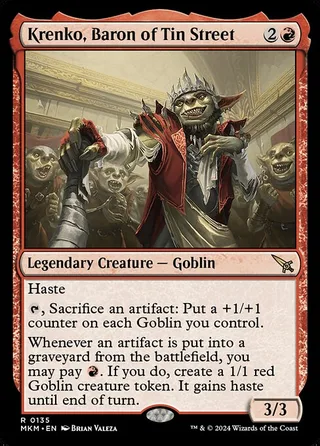
Turn disposable artifacts into a stronger Goblin army.
The Baron ties Goblins to artifacts. Sacrificing an artifact to his activated ability puts counters on your Goblins, and an artifact going from the battlefield to any graveyard gives you the option to pay one red mana for another Goblin. Treasures and cheap artifacts give you material for both abilities.
The optional red payments add up. If you spend every Treasure making Goblins, you may have nothing left to cast the next card. Useful artifacts and other sacrifice outlets keep the deck working without Krenko, while artifact exile won't trigger the graveyard ability at all. This is the artifact-heavy Goblin choice; Mob Boss remains the simpler army maker.
776 EDHREC decks (past two years; October 4, 2026). Oracle text and rulings. Compare singles printings and prices.
Shop Krenko, Baron of Tin Street7. Ib Halfheart, Goblin Tactician
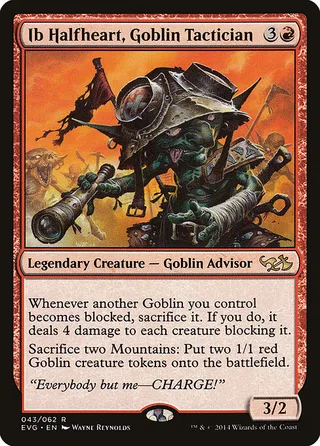
Blocking your Goblins comes with a price.
Ib makes your other blocked Goblins sacrifice themselves and deal damage to each creature blocking them. That changes which blocks an opponent can afford. He can also turn two Mountains into two Goblins, but you're giving up lands you'll need on later turns. The tokens do not erase the cost.
That land sacrifice is the reason to approach Ib as a specialist. A deck with ways to draw and rebuild its lands can make use of the exchange; a new player who just wants more Goblins will usually have an easier time with Krenko. Ib offers unusual combat pressure, but it comes with decisions about resources you can't take back.
1,081 EDHREC decks (past two years; October 4, 2026). Oracle text and rulings. Compare singles printings and prices.
Shop Ib Halfheart, Goblin Tactician8. Grenzo, Havoc Raiser
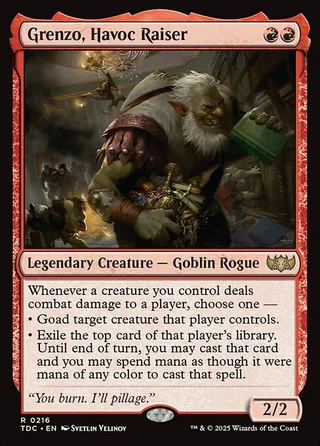
Small attackers can borrow spells or send trouble elsewhere.
Grenzo gives each creature that hits a player a choice: goad one of that player's creatures, or exile the top card of their library and get a chance to cast it. Several small creatures can create several useful triggers. Haste and ways to get past blockers matter more here than making one huge attacker.
You still need mana to cast a stolen card before its short window closes. Sometimes you won't be able to use it at all, so this isn't dependable draw. Goad can help steer attacks toward other players, but it does much less for you once only one opponent remains. Your own creatures still need a way to win that last fight.
932 EDHREC decks (past two years; October 4, 2026). Oracle text and rulings. Compare singles printings and prices.
Shop Grenzo, Havoc RaiserMono-red theme
Best Mono-Red Commanders for Treasure, Dwarves and stolen spells
Magda, Brazen Outlaw makes Treasure and finds the card you need. If you would rather earn Treasure through interaction or attacks, the other choices give you a different route.
1. Magda, Brazen Outlaw
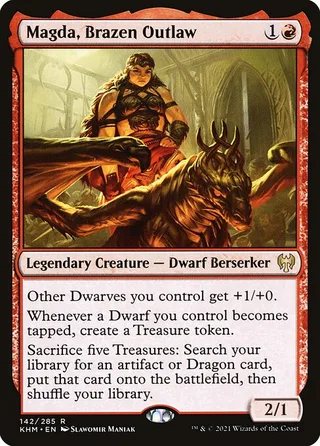
Treasure, Dwarves and the exact card you need.
Magda makes Treasure when your Dwarves become tapped. They can crew a Vehicle instead of attacking, so you don't have to risk them in combat to get started. Once you have five Treasures, you can sacrifice them to put an artifact or Dragon from your library onto the battlefield. Few commanders combine mana and that much choice so neatly.
What you search for changes the entire deck. A Dragon toolbox and a compact combo deck may share Magda but play very differently. Clock of Omens combinations need the right artifacts and tapping arrangement; five Treasures aren't a win on their own. The tournament section covers the dated competitive evidence separately, so you can distinguish a useful ability from a recorded result.
17,969 EDHREC decks (past two years; October 4, 2026). Oracle text and rulings. Compare singles printings and prices.
Shop Magda, Brazen Outlaw2. Magda, the Hoardmaster
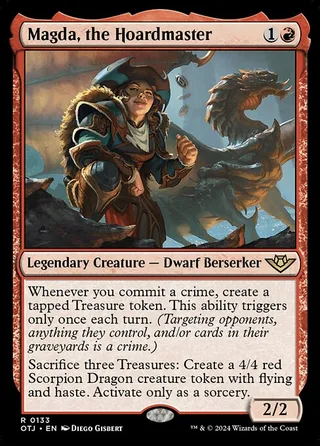
Play interaction, collect Treasure, make a Dragon.
This Magda rewards crimes with one tapped Treasure each turn. Targeting an opponent, something they control or a card in their graveyard can qualify. Cheap interaction on several players' turns therefore does more than casting several targeted spells on your own turn. Three Treasures can then become a flying, hasty Scorpion Dragon.
The Hoardmaster is the more direct choice for a deck that wants to interact and eventually attack with Dragons. She doesn't search your library like Brazen Outlaw. Her Dragon ability works only at sorcery speed, and the new Treasures enter tapped. You won't get immediate mana from them or make a surprise blocker during someone else's attack.
1,342 EDHREC decks (past two years; October 4, 2026). Oracle text and rulings. Compare singles printings and prices.
Shop Magda, the Hoardmaster3. Smaug the Magnificent
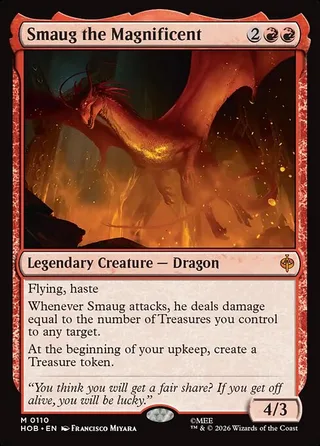
Every Treasure you keep makes the next attack hurt more.
Smaug makes a Treasure on your upkeep and deals damage when he attacks equal to the Treasures you control. That creates a useful choice: spend the stockpile to cast more spells, or keep it to make his next attack more dangerous. Flying and haste help you get that first attack trigger.
One Treasure each upkeep is a slow way to fund an expensive deck, so Smaug needs other Treasure makers and draw. He's the Dragon threat you choose when keeping a stockpile sounds appealing; Magda gives you more direct access to what your deck needs. Losing those artifacts hurts both your future mana and Smaug's damage.
4,170 EDHREC decks (past two years; October 4, 2026). Oracle text and rulings. Compare singles printings and prices.
Shop Smaug the Magnificent4. Knuckles the Echidna
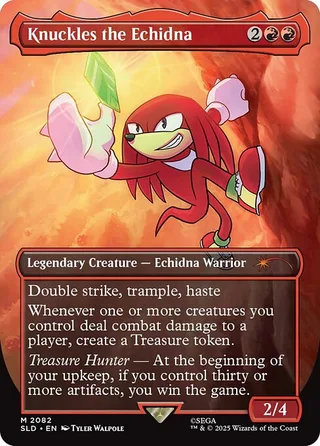
Attack for Treasure, with thirty artifacts as a second finish.
Double strike, trample and haste give Knuckles a clear combat role. Your creatures dealing combat damage to a player also make Treasure: each qualifying event gives one, not one for every creature involved. Separate combat-damage steps can help you build the pile. His other route to winning asks you to reach thirty artifacts.
That's a substantial target, and you need thirty artifacts both when the upkeep begins and when the win trigger resolves. Opponents can remove enough artifacts in response to stop it. Useful artifact cards let the deck keep attacking while you work toward that number. A pile of tokens that does nothing else is a much less dependable plan.
4,098 EDHREC decks (past two years; October 4, 2026). Oracle text and rulings. Compare singles printings and prices.
Shop Knuckles the Echidna5. Ragavan, Nimble Pilferer
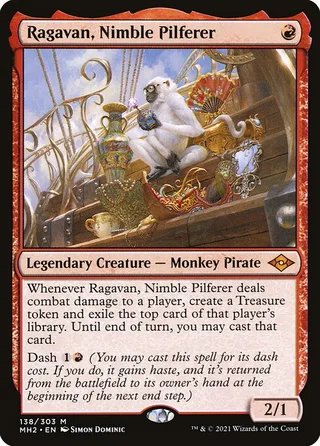
A quick start doesn't guarantee a strong multiplayer finish.
Ragavan costs one mana and rewards hitting a player with a Treasure and a chance to cast their top card that turn. Dash gives him haste and brings him back to your hand, though you'll have to pay again to use it again. He's good at getting started early; keeping up with three opponents is a separate problem.
This is an appealing commander if you like cheap attacks, disruption and whatever spells an opponent happens to reveal. Ground blockers can stop the whole engine, and a stolen card may be too expensive or simply unhelpful. Ragavan's reputation in other formats doesn't answer those multiplayer problems or replace Commander results.
3,042 EDHREC decks (past two years; October 4, 2026). Oracle text and rulings. Compare singles printings and prices.
Shop Ragavan, Nimble Pilferer6. J. Jonah Jameson
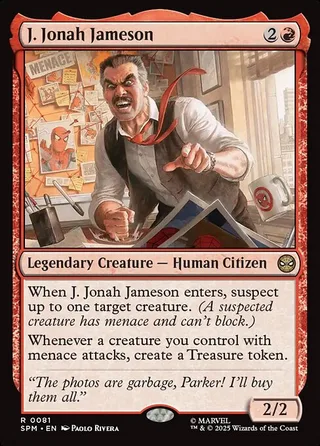
Menace attackers pay for your next play.
Jameson makes a Treasure whenever one of your creatures with menace attacks. Several menace creatures can therefore turn an attack into mana for what comes next. His entry ability can suspect a creature, giving it menace while also preventing it from blocking. You can improve your own attacker or use that downside against an opposing blocker.
The deck needs enough creatures with the right keyword to make Jameson worthwhile. A generic collection of red attackers won't earn the same Treasures. Card access and protection are the other half of the build: the mana from a successful attack won't refill your hand after someone clears the board.
1,349 EDHREC decks (past two years; October 4, 2026). Oracle text and rulings. Compare singles printings and prices.
Shop J. Jonah Jameson7. Vaan, Street Thief
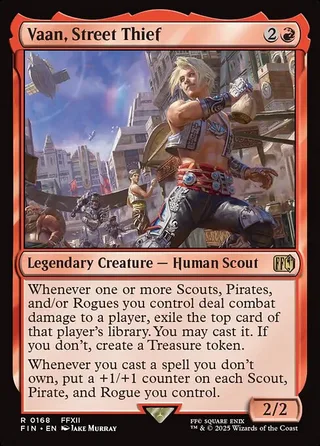
Scouts, Pirates and Rogues get paid when they connect.
Vaan lets your Scouts, Pirates and Rogues exile the top card of a player they've hit. You can cast that card immediately, or decline and make a Treasure. Casting spells you don't own also grows the creatures Vaan supports, so borrowing a useful spell helps your next attack as well.
Unlike Grenzo or Ragavan, Vaan asks you to commit to particular creature types. You need enough eligible attackers and mana ready for the offered spells. You can't save every exiled card for a more convenient turn. The counters improve a surviving army, but they won't help if removal leaves you without creatures.
1,299 EDHREC decks (past two years; October 4, 2026). Oracle text and rulings. Compare singles printings and prices.
Shop Vaan, Street ThiefMono-red theme
Best Mono-Red Commanders for Burn and damage multipliers
Start with the damage you want to deal. Solphim doubles noncombat damage, Axonil improves small red pings, and Torbran helps red combat damage too.
1. Solphim, Mayhem Dominus
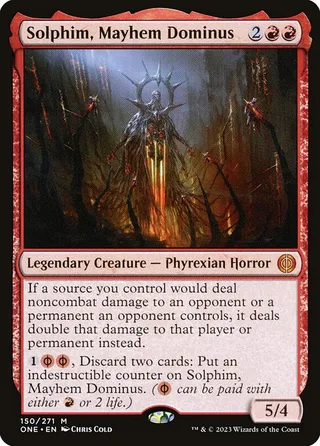
Our straightforward starting point for burn.
Solphim doubles noncombat damage from your sources to opponents and their permanents. You can use large burn spells, little repeatable pings or colorless sources that Torbran wouldn't help. That broad coverage makes Solphim easy to build around when the rest of your deck already provides damage and cards.
An indestructible counter can help him survive destruction, but the activation costs two discarded cards as well as its other payment. Exile and sacrifice still answer him. You'll also win through ordinary damage here: noncombat damage from a commander doesn't count toward the twenty-one commander combat-damage rule.
5,359 EDHREC decks (past two years; October 4, 2026). Oracle text and rulings. Compare singles printings and prices.
Shop Solphim, Mayhem Dominus2. Ojer Axonil, Deepest Might
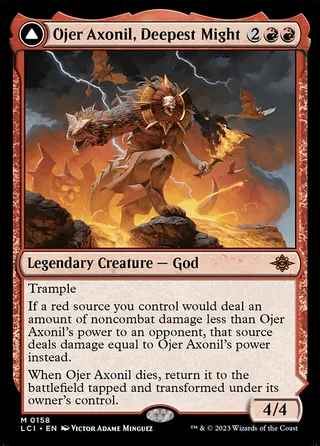
Small red pings become much bigger problems.
Axonil raises qualifying red-source noncombat damage to opponents up to his power when the original damage is lower. That makes repeated little pings worth building around. Increasing his power can raise the damage further, but the effect won't improve damage aimed at creatures. He's our pick when small red damage is the deck's main attraction.
Several replacement effects can make the arithmetic less generous than it first looks. The affected player chooses the applicable order, so you can't assume Axonil and a damage doubler combine in your favorite sequence. His land face gives you a way back after he dies, but changing it back requires the stated damage condition and a sorcery-speed activation.
10,346 EDHREC decks (past two years; October 4, 2026). Oracle text and rulings. Compare singles printings and prices.
Shop Ojer Axonil, Deepest Might3. Torbran, Thane of Red Fell
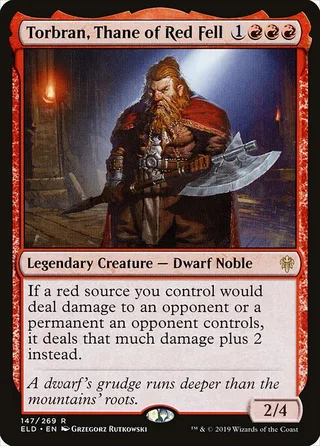
Add two damage to the red attacks and pings you already want.
Torbran adds two damage when your red sources damage an opponent or something they control. Combat damage qualifies too. The bonus makes a series of small hits grow more than one big hit, giving red tokens and repeatable pingers a useful place in the same deck.
That combat coverage is the reason to choose Torbran over a purely noncombat multiplier. Colorless artifact damage doesn't get the bonus, though, and your own creatures don't gain protection from a sweeper. You'll still need draw and threats that function without him; a board of weak pingers becomes much less impressive after he's removed.
4,424 EDHREC decks (past two years; October 4, 2026). Oracle text and rulings. Compare singles printings and prices.
Shop Torbran, Thane of Red Fell4. Hawkeye, Young Avenger
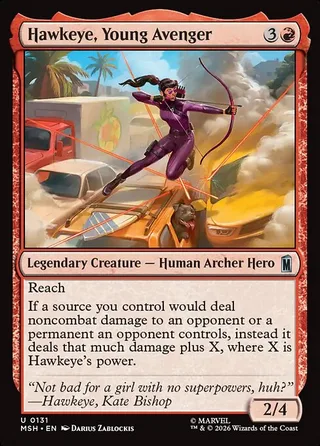
Grow Hawkeye and each noncombat hit gets larger.
Hawkeye adds his power to qualifying noncombat damage from your sources against opponents and their permanents. Equipment, counters and temporary pumps can all improve the addition. Those sources don't have to be red, so an artifact damage package can benefit too.
The extra flexibility comes with work. You need damage sources and ways to raise Hawkeye's power, while Solphim can simply double the damage. Pumps are less useful without Hawkeye, and a large Hawkeye has no damage to improve if you lose the pingers. Cards that still do something on their own make both setbacks easier to recover from.
618 EDHREC decks (past two years; October 4, 2026). Oracle text and rulings. Compare singles printings and prices.
Shop Hawkeye, Young Avenger5. Imodane, the Pyrohammer
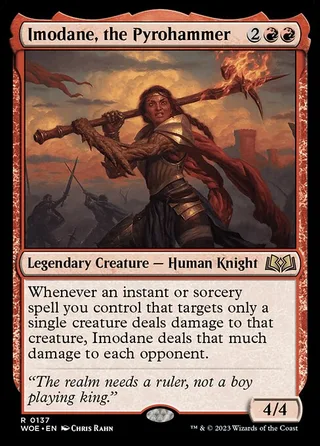
Burn one creature and damage every opponent.
Imodane turns an instant or sorcery that damages just one targeted creature into damage for each opponent as well. A large creature-only burn spell can answer a threat and move you much closer to winning. The amount comes from damage actually dealt to that creature, so prevention changes what Imodane passes along.
The spell must target only one creature. Targeting a player or several creatures won't qualify just because the spell deals damage. That restriction is why the card choices matter more than the size of the burn spell alone. Draw keeps the deck supplied; a hand of expensive damage spells without a way to find the next one can stall.
6,691 EDHREC decks (past two years; October 4, 2026). Oracle text and rulings. Compare singles printings and prices.
Shop Imodane, the Pyrohammer6. Toralf, God of Fury
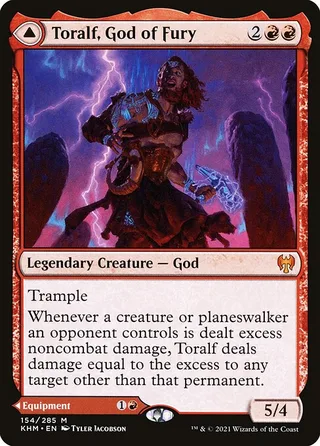
A damage sweeper can keep bouncing excess damage around.
Toralf turns excess noncombat damage to an opposing creature or planeswalker into another shot. A large damage sweeper can give you several triggers at once. If you send the new damage at another suitable permanent and deal excess again, you can get another trigger. That's the attraction of building your removal around damage.
The opposing board determines how far that goes. With few creatures or planeswalkers to hit, a sweeper may offer very little extra damage. You'll need to follow the targets and excess amounts rather than assume any wipe wins. Toralf's Hammer is another way to use the card, but casting the Hammer doesn't also put Toralf's creature-side engine in play.
1,355 EDHREC decks (past two years; October 4, 2026). Oracle text and rulings. Compare singles printings and prices.
Shop Toralf, God of Fury7. Heartless Hidetsugu
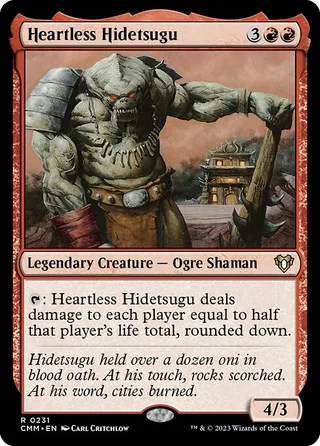
Halve life totals carefully, including your own.
Hidetsugu damages each player for half their life total, rounded down. That includes you. At 13 life, he deals 6 and leaves 7. Haste or an untap effect can give you an earlier activation, while damage multipliers and prevention can change whether anyone survives it. The arithmetic matters much more here than with an ordinary burn spell.
If your deck can end the game with a fast combo, tell the other players before you start. Doubling Hidetsugu's damage can be lethal at an even life total while leaving a player at an odd total alive. You'll need a finish that accounts for that difference and your own life total. Repeatedly halving everyone's life isn't an automatic win.
2,036 EDHREC decks (past two years; October 4, 2026). Oracle text and rulings. Compare singles printings and prices.
Shop Heartless HidetsuguMono-red theme
Best Mono-Red Commanders for Spells, storm and copying
Zada turns one targeted spell into help for an army. Birgi and the other spell commanders solve different problems, from paying for the next cast to copying it or dealing damage.
1. Zada, Hedron Grinder
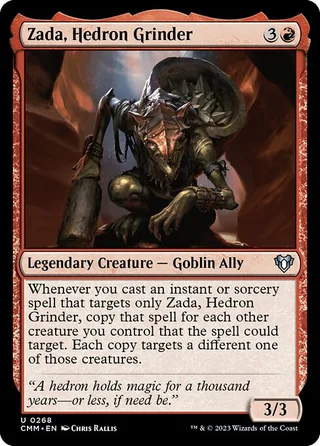
One cheap cantrip can refill a whole army's worth of cards.
Zada copies an instant or sorcery you cast that targets only her for every other creature it could legally target. With a token army, a one-creature cantrip such as Crimson Wisps can draw many cards. That's why Zada is our first choice for creature-based spell chains. The army has to be there first, and the spell's targeting restrictions still apply.
You'll also need mana to use the cards you draw. Once her cast trigger is on the stack, removing Zada does not stop that trigger from making copies for the remaining legal creatures. Removing her before your next spell stops the next trigger. A sweeper is more damaging still because it can remove the creatures that would receive the copies.
15,853 EDHREC decks (past two years; October 4, 2026). Oracle text and rulings. Compare singles printings and prices.
Shop Zada, Hedron Grinder2. Ashling, Flame Dancer
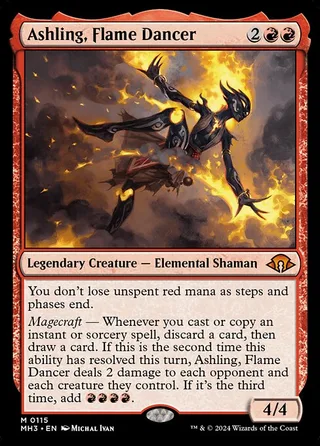
Casts and copies feed the same spell engine.
Ashling's magecraft makes you discard and then draw on each resolution. The second resolution in a turn also damages opponents and their creatures; the third adds four red mana. Casts and copies both count, giving cheap interaction and copy spells a place in the same chain. Her unspent red mana stays available as steps and phases change.
The second and third resolutions are particular milestones. You don't get their bonuses on every later resolution that turn. That makes the order of your spells important. Graveyard access can help recover discarded cards, but discarding one doesn't automatically give you permission to cast it later.
4,925 EDHREC decks (past two years; October 4, 2026). Oracle text and rulings. Compare singles printings and prices.
Shop Ashling, Flame Dancer3. Urabrask
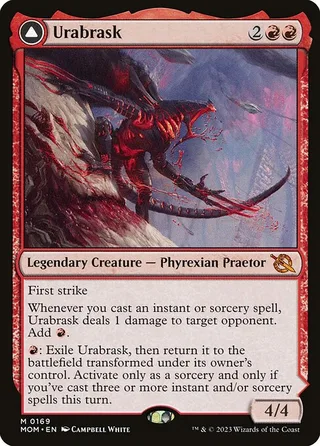
Get mana back from spells, or trade the engine for a Saga.
This Urabrask adds red mana and pings an opponent whenever you cast an instant or sorcery. After three qualifying casts in a turn, you can use his sorcery-speed ability to become The Great Work. The Saga gives you removal, Treasures and a one-turn chance to cast spells from graveyards.
Changing faces means giving up the creature's mana and damage engine for a while. If you're still casting spells that turn, keeping Urabrask may be more useful than transforming immediately. Other noncreature spells don't trigger him, and a spell copy that wasn't cast doesn't either. Those limits distinguish him from Birgi and Ashling.
4,026 EDHREC decks (past two years; October 4, 2026). Oracle text and rulings. Compare singles printings and prices.
Shop Urabrask4. Birgi, God of Storytelling
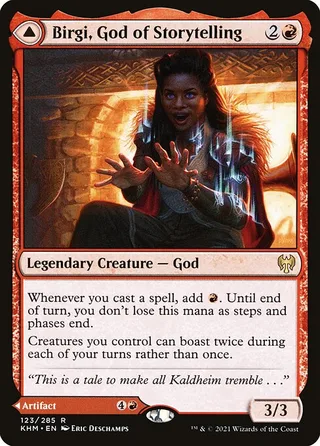
A mana refund for every spell you cast.
Birgi makes one red mana whenever you cast a spell, and that mana stays available through steps and phases until the turn ends. Cheap artifacts work alongside cantrips and red spells, so she's a broader cast engine than Urabrask. Her other face, Harnfel, lets you discard a card for two temporary options from exile.
You choose which face to deploy; casting Birgi doesn't give you Harnfel too. The mana helps you keep casting, but it doesn't supply another card or a way to win by itself. A real loop needs to pay for the next cycle and keep the cards coming. Harnfel solves a different problem when what you need is more spells to choose from.
1,427 EDHREC decks (past two years; October 4, 2026). Oracle text and rulings. Compare singles printings and prices.
Shop Birgi, God of Storytelling5. Electro, Assaulting Battery
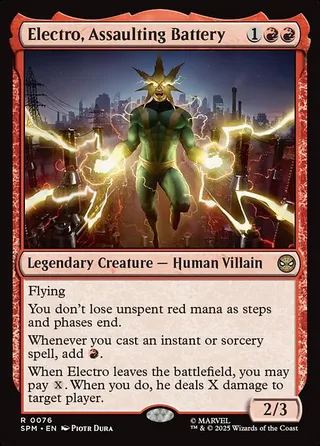
Bank red mana, then spend it when Electro leaves.
Electro makes red mana from instant and sorcery casts and lets you keep unspent red mana as steps and phases change, including across turns while its ability applies. When Electro leaves the battlefield, you may spend mana to damage a target player. A spell chain can therefore build both its resources and its eventual damage without attacking.
Birgi's mana lasts until the end of the turn; Electro's retention ability has no such limit. Even so, you need the mana available when Electro's leave trigger resolves. Removing the commander won't create it for you. The deck needs a way to make Electro leave at a useful moment and interaction to keep your spell chain from falling apart first.
3,302 EDHREC decks (past two years; October 4, 2026). Oracle text and rulings. Compare singles printings and prices.
Shop Electro, Assaulting Battery6. Longshot, Rebel Bowman
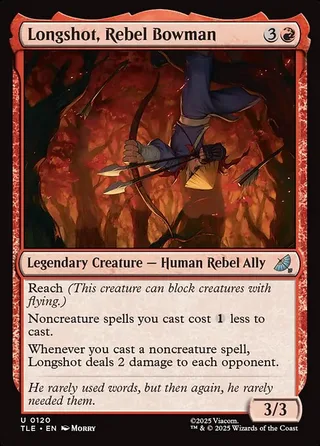
Cheaper noncreature spells that hurt everyone on the way.
Longshot reduces the generic part of your noncreature spells' costs and deals two damage to each opponent when you cast one. Artifacts and enchantments count alongside instants and sorceries. That makes him an appealing choice for a mixed noncreature deck rather than one built entirely around a particular spell combination.
The reduction won't pay colored mana requirements, and a spell that's already free can't get cheaper. Look at the costs of the cards you actually want to cast before valuing the discount. Draw is just as important as the damage trigger: you'll need another card to keep the next cast coming.
1,501 EDHREC decks (past two years; October 4, 2026). Oracle text and rulings. Compare singles printings and prices.
Shop Longshot, Rebel Bowman7. The Scarlet Witch
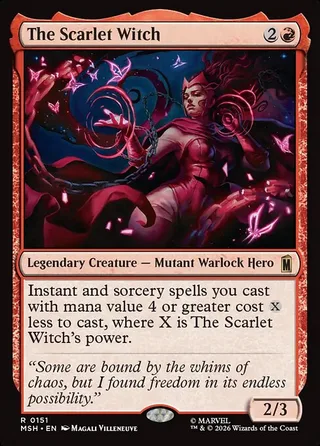
Make larger spells affordable by raising her power.
The Scarlet Witch reduces the cost of instants and sorceries with mana value four or greater by her power. She gives you a reason to play substantial spells and ways to grow her, rather than fill the deck with the cheapest cantrips. A reduction changes what you pay, not the spell's mana value.
Colored requirements still have to be paid. A large discount won't make every qualifying spell free, and it won't find you more cards or finish the game. Compared with Longshot, she supports bigger instants and sorceries but asks you to maintain her power. That extra dependence is the trade for a larger potential saving.
2,120 EDHREC decks (past two years; October 4, 2026). Oracle text and rulings. Compare singles printings and prices.
Shop The Scarlet Witch8. Thor, God of Thunder
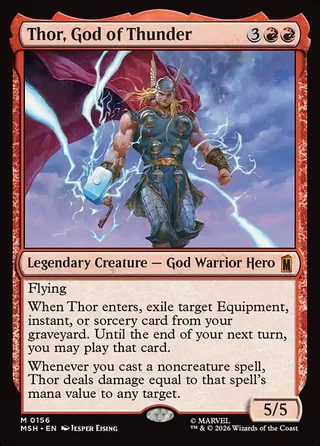
Spend less mana without shrinking the damage trigger.
Thor gives an Equipment, instant or sorcery from your graveyard a limited play window when he enters. His other ability damages any target based on the mana value of each noncreature spell you cast. Cost reductions don't lower that value. For an X spell on the stack, the chosen X counts toward mana value; what you spent and what the spell is worth can differ.
That gives useful large spells with lower actual costs a reason to be in the deck. The recovered card is still temporary access, and you still pay to cast it. Imodane wants burn aimed at a single creature; Thor gives you more freedom with spells and targets. You'll need enough mana left after casting him to take advantage of the graveyard card.
1,545 EDHREC decks (past two years; October 4, 2026). Oracle text and rulings. Compare singles printings and prices.
Shop Thor, God of Thunder9. Syr Carah, the Bold
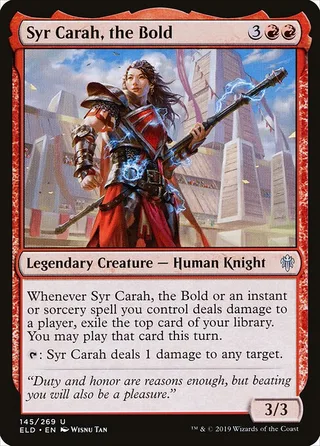
Burn players to find the next spell.
Syr Carah turns player damage from herself or your instants and sorceries into cards you can play from exile that turn. A spell hitting several players can give you several triggers. Her tap ability gives you another damage source once she's able to use it. Creature-only burn won't open those extra cards.
You'll need mana left to use what you reveal. An unused land play can matter too, because the cards aren't going into your hand to wait for next turn. Syr Carah can keep a burn chain moving, but the first spell still needs to leave you enough resources to cast whatever comes next.
599 EDHREC decks (past two years; October 4, 2026). Oracle text and rulings. Compare singles printings and prices.
Shop Syr Carah, the Bold10. Mica, Reader of Ruins
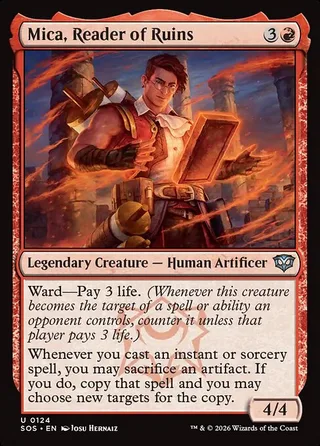
Spend a spare artifact to get more from a spell.
Whenever you cast an instant or sorcery, Mica lets you sacrifice an artifact to copy it. You can choose new targets for the copy. Treasures and other expendable artifacts give a useful spell a second job, though the copy itself isn't another cast and won't trigger abilities that require casting.
The deck needs both spells worth copying and artifacts you can afford to lose. Sacrificing a Treasure means you can't spend it for mana, and copying a draw spell still requires the original card. Mica makes sense when those two supplies already support each other; a general artifact deck won't necessarily have enough spells to reward the choice.
1,475 EDHREC decks (past two years; October 4, 2026). Oracle text and rulings. Compare singles printings and prices.
Shop Mica, Reader of RuinsMono-red theme
Best Mono-Red Commanders for Creature entries and Devils
Purphoros makes creature entries hurt every opponent. Norin keeps returning to use those payoffs, while Zurzoth supplies an unpredictable Devil army.
1. Purphoros, God of the Forge
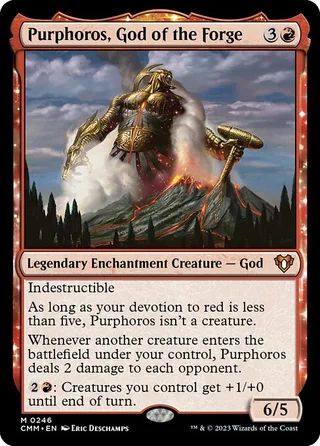
Make creatures and let Purphoros handle the damage.
Purphoros deals two damage to each opponent whenever another creature enters under your control. A token maker can produce several triggers without attacking, and summoning sickness doesn't get in the way. His indestructible helps him stay around. The damage ability also keeps working when low devotion leaves him as an enchantment rather than a creature.
He's our broad starting recommendation for creature-entry damage because the payoff is so direct. You still need the creatures and draw to feed it. Exile and enchantment removal can answer him, and an indestructible Purphoros won't accomplish much on an empty board if you've run out of token makers.
4,856 EDHREC decks (past two years; October 4, 2026). Oracle text and rulings. Compare singles printings and prices.
Shop Purphoros, God of the Forge2. Norin the Wary
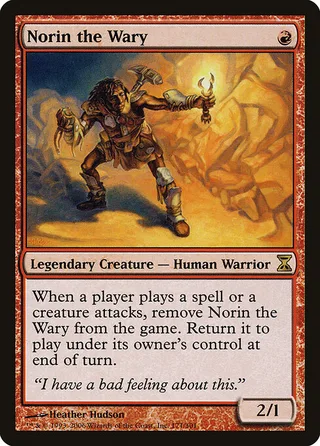
He keeps leaving, then comes back to trigger your payoffs.
Norin exiles himself when a player casts a spell or a creature attacks, then returns at the next end step. You'll rarely get a conventional attack out of him. His repeated returns are the point: a card such as Impact Tremors turns each new entry into something useful for the deck.
At one mana, Norin is cheap to deploy, but the rest of the deck has plenty of work to do. Entry payoffs give him a purpose, and other useful cards let you keep playing when those payoffs are removed. Keeping track of the delayed return matters more here than trying to turn Norin into a combat threat.
9,143 EDHREC decks (past two years; October 4, 2026). Oracle text and rulings. Compare singles printings and prices.
Shop Norin the Wary3. Zurzoth, Chaos Rider
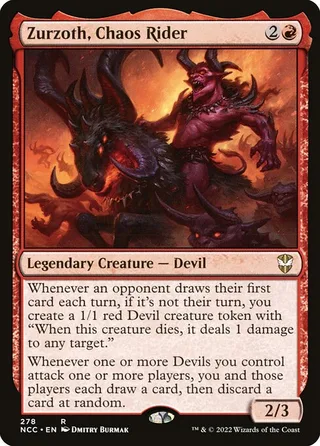
An unpredictable Devil army that grows on other players' turns.
Zurzoth makes a Devil when an opponent draws their first card on a turn that isn't theirs. Attacking players with Devils makes you and those players draw and randomly discard, which can help create more Devils. When the tokens die, their damage gives them something to do beyond combat.
The first-card condition limits how many draws actually count. Random discards also mean you can't rely on keeping a particular card in hand. Graveyard utility and more than one way to finish make that uncertainty easier to live with. Zurzoth is a good direction if the randomness appeals to you; precise hand sculpting is a different deck.
3,642 EDHREC decks (past two years; October 4, 2026). Oracle text and rulings. Compare singles printings and prices.
Shop Zurzoth, Chaos RiderMono-red theme
Best Mono-Red Commanders for Artifact recovery and toolbox plans
Daretti, Scrap Savant gives you a clear way to reuse artifacts. The alternatives ask whether you would rather sacrifice them for mana, copy their abilities or find new ones by attacking.
1. Daretti, Scrap Savant
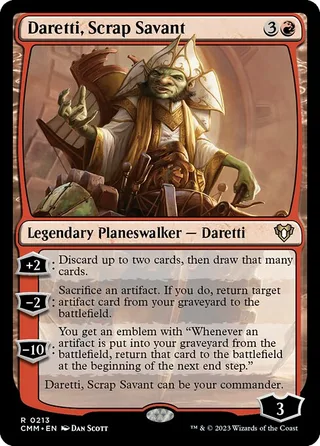
Discard an expensive artifact, then bring it back.
Daretti's plus ability discards and draws, helping you put artifacts into the graveyard for his minus ability. That minus trades an artifact on your battlefield for one in the graveyard. You don't need to reach his expensive ultimate for that exchange to be useful. He also explicitly permits being your commander, unlike most planeswalkers.
Cheap artifacts to sacrifice and worthwhile ones to recover are the foundation. Protecting Daretti from attacks lets you make more exchanges, while graveyard exile can stop them. He is our artifact-recovery starting point. If your targets repeatedly lock the other players out or produce a fast combo, explain that before the game.
3,312 EDHREC decks (past two years; October 4, 2026). Oracle text and rulings. Compare singles printings and prices.
Shop Daretti, Scrap Savant2. Daretti, Rocketeer Engineer
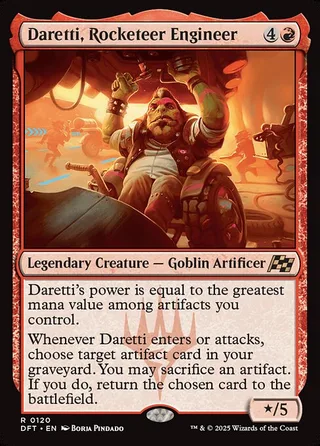
The creature Daretti trades artifacts on entry and attacks.
Rocketeer Engineer can exchange an artifact for one in your graveyard when he enters or attacks. His power reflects the largest artifact mana value you control, so an expensive recovered artifact can help his combat plan too. Unlike Scrap Savant, he can use haste to reach that next attack sooner.
The choice between Darettis comes down to what you need. Rocketeer gives immediate entry value and more exchanges through combat; Scrap Savant helps discard the cards you want to recover. A large power number doesn't guarantee a safe attack. Both decks still need graveyard setup, or those costly artifacts may sit uselessly in your hand.
820 EDHREC decks (past two years; October 4, 2026). Oracle text and rulings. Compare singles printings and prices.
Shop Daretti, Rocketeer Engineer3. Farid, Enterprising Salvager
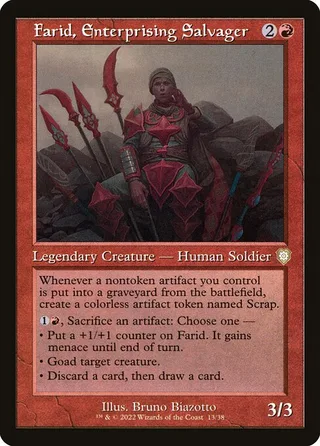
Your used artifacts leave behind another resource.
When a nontoken artifact you control goes from the battlefield to the graveyard, Farid makes a Scrap token. His activated ability can sacrifice an artifact to add counters and menace, goad a creature, or discard and draw. The Scrap gives you material for those choices; it doesn't have a printed ability to make mana itself.
Farid is a quieter sacrifice commander than a direct artifact tutor. You need nontoken artifacts to keep the supply coming, because sacrificing Scrap won't replace itself. The modes are choices, too. A sacrifice that improves combat isn't also drawing a card, so pick the effect that solves the problem in front of you.
886 EDHREC decks (past two years; October 4, 2026). Oracle text and rulings. Compare singles printings and prices.
Shop Farid, Enterprising Salvager4. Slobad, Iron Goblin
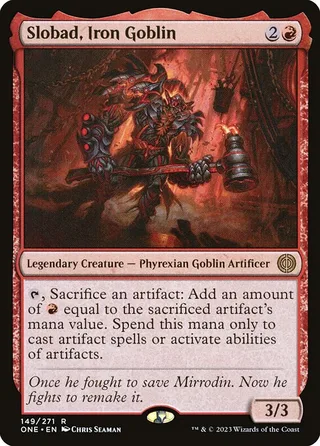
Trade one artifact for the mana to use another.
Slobad sacrifices an artifact and makes red mana equal to its mana value. You can spend that mana only on artifact spells or artifact abilities. That makes him a way to move between useful artifacts, rather than pay for any red spell you like. Ordinary tokens without a copied mana cost won't provide a large payment.
Recoverable artifacts give you a way to make the exchange pay off over time. Otherwise, sacrificing an expensive permanent may simply cost you a card and a useful board presence. You'll also need an artifact worth spending the mana on. Since Slobad has to tap, haste and protection help him make that first exchange.
570 EDHREC decks (past two years; October 4, 2026). Oracle text and rulings. Compare singles printings and prices.
Shop Slobad, Iron Goblin5. Kurkesh, Onakke Ancient
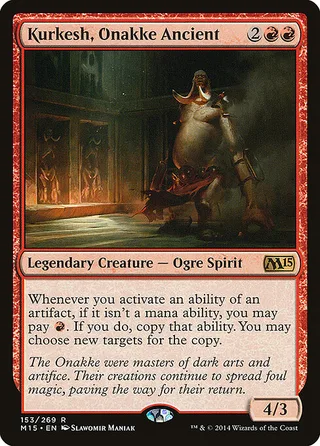
One red mana buys a second artifact activation.
Kurkesh can copy an activated ability of an artifact for one red mana, as long as it isn't a mana ability. Utility and sacrifice abilities can become much more useful that way. Sol Ring doesn't qualify: the exclusion means a collection of mana rocks alone gives Kurkesh little to copy.
Start with the actual abilities you want to repeat. You pay the original activation's cost once, then the red mana for Kurkesh's copy; you don't pay that original cost again. That can be a useful saving, but you still need the artifact and the first activation. He rewards a deliberate set of targets more than general artifact density.
533 EDHREC decks (past two years; October 4, 2026). Oracle text and rulings. Compare singles printings and prices.
Shop Kurkesh, Onakke Ancient6. Bosh, Iron Golem
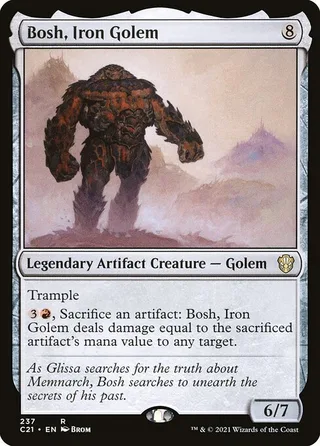
Large artifacts become ammunition, if you can afford the throw.
Bosh sacrifices an artifact to deal its mana value in targeted damage. The activation is a substantial payment on top of getting Bosh into play. Artifacts with useful entry or death effects do more for you than expensive cards chosen only for their mana value. His red activation also gives him red color identity despite a colorless casting cost.
This is a deck about mana and reusing artifacts. One throw rarely answers the whole multiplayer game, so you'll want a way to recover the ammunition and activate again. Tokens without a copied mana cost contribute little damage. Graveyard exile can stop the recovery plan just when you need to reload.
828 EDHREC decks (past two years; October 4, 2026). Oracle text and rulings. Compare singles printings and prices.
Shop Bosh, Iron Golem7. Chiss-Goria, Forge Tyrant
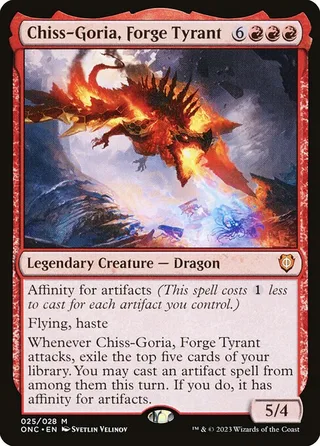
Cheap artifacts help cast both your commander and its finds.
Affinity for artifacts makes Chiss-Goria cheaper to cast. When it attacks, you exile five cards and can cast one artifact spell from them that turn with affinity as well. Flying and haste help you reach the first attack immediately. Cheap artifacts support both the commander's cost and the spell you find.
The top five still need to contain something worthwhile. Nonartifact interaction has its place, but too many unrelated cards reduce your chances of finding a useful artifact. You get permission for one artifact spell, not all five cards, and affinity won't pay its remaining colored requirements. That's the balance to watch as you build.
4,215 EDHREC decks (past two years; October 4, 2026). Oracle text and rulings. Compare singles printings and prices.
Shop Chiss-Goria, Forge Tyrant8. RMS Titanic
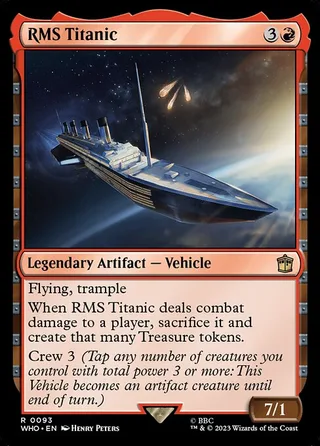
One successful attack becomes a pile of Treasure.
RMS Titanic qualifies as a commander because it's a legendary Vehicle with printed power and toughness under the current rules. After you crew it, flying and trample help it connect. Dealing combat damage to a player sacrifices it and makes that much Treasure. You're exchanging the Vehicle for resources, rather than keeping a draw engine around.
The deck needs creatures to crew it, a way through blockers and something worthwhile to cast with the Treasures. Recasting it from the command zone gets more expensive, though its combat damage still belongs to the same commander. This is a distinctive project; Magda is our easier starting recommendation for a more general Treasure deck.
1,251 EDHREC decks (past two years; October 4, 2026). Oracle text and rulings. Compare singles printings and prices.
Shop RMS Titanic9. Jaws, Relentless Predator

Attack for Blood, then make sacrificed artifacts hurt.
Jaws makes Blood tokens equal to its combat damage to a player. Haste and trample help it get started. Its other ability damages each opponent when any noncreature artifact is sacrificed or destroyed, including an opponent's artifact. Using Blood can therefore filter your hand and supply an artifact sacrifice for the damage ability.
That filtering costs mana and a discarded card. It isn't a free extra hand, so draw still belongs in the deck. Exiling an artifact also won't satisfy the sacrifice-or-destruction condition. Jaws fits players who want to connect in combat and then turn those artifacts into more damage, rather than rely entirely on either half.
6,749 EDHREC decks (past two years; October 4, 2026). Oracle text and rulings. Compare singles printings and prices.
Shop Jaws, Relentless PredatorMono-red theme
Best Mono-Red Commanders for Creature copies
Kiki-Jiki is our first choice for repeating useful nonlegendary creatures. Your other options depend on whether you want to cast spells, discard, roll dice or saddle a creature before combat.
1. Kiki-Jiki, Mirror Breaker
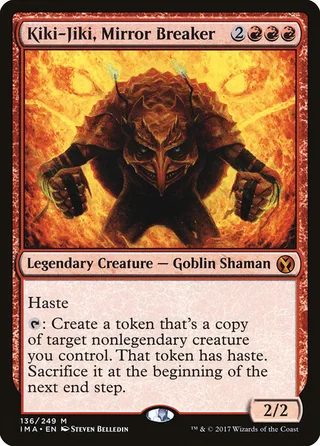
Get another use out of your best nonlegendary creature.
Kiki-Jiki has haste and taps to copy another nonlegendary creature you control. The copy has haste too, then is sacrificed later. A useful entry ability can repay the activation immediately, with combat or death effects adding more. The restriction on legendary targets matters when choosing the creatures that make this deck work.
He's our first choice for a copy toolbox when those creatures are useful on their own. Untap combos need the exact legal pieces; white Restoration Angel can't go in a mono-red list. You can build for ordinary repeated value or a faster verified combo, but tell the other players which version you're bringing.
1,004 EDHREC decks (past two years; October 4, 2026). Oracle text and rulings. Compare singles printings and prices.
Shop Kiki-Jiki, Mirror Breaker2. Rionya, Fire Dancer
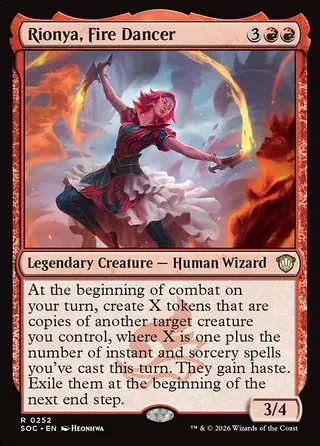
Cast spells before combat to make more copies.
At the beginning of your combat, Rionya makes copies equal to the number of instants and sorceries you've cast that turn, plus one. They have haste and disappear at the next end step. You can get value from a suitable creature without casting a spell first, but a busy spell turn makes the payoff much larger.
The deck needs good copy targets as well as spells worth casting before combat. Rionya does not remove legendary status, so copying a legendary creature normally leaves you keeping only one with that name. The copies can attack normally, but making them isn't casting them. Extra-combat combinations also depend on the exact target, timing and spell count; the copy ability alone isn't an unrestricted infinite.
3,362 EDHREC decks (past two years; October 4, 2026). Oracle text and rulings. Compare singles printings and prices.
Shop Rionya, Fire Dancer3. Feldon of the Third Path
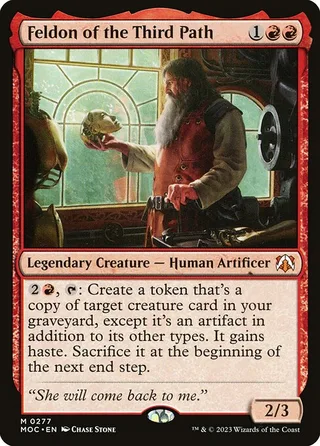
Reuse a creature in your graveyard without moving the original.
Feldon makes a hasty artifact creature token copy of a creature card in your graveyard. Entry, combat and death effects can all matter before the delayed sacrifice. The original card stays where it was, letting a later activation use it again if your graveyard is still available.
Feldon won't fill that graveyard for you. Discard outlets and worthwhile creatures give him something to copy, while support for the three-mana tap ability helps you repeat it. The token being an artifact opens extra interactions and removal risks. Graveyard exile can also remove the target before the activation resolves, leaving you without the copy.
2,309 EDHREC decks (past two years; October 4, 2026). Oracle text and rulings. Compare singles printings and prices.
Shop Feldon of the Third Path4. Jaxis, the Troublemaker
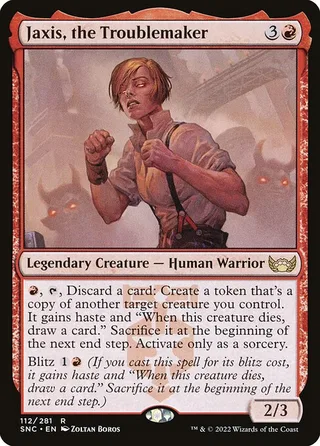
Discard a card for a creature copy that can replace it later.
Jaxis uses red mana, a tap and a discarded card to make a temporary hasty creature copy. The copy draws you a card when it dies, so entry and death effects can both repay the exchange. Blitz offers another way to deploy Jaxis, with haste, a death draw and a delayed sacrifice of its own.
Her activated ability works only at sorcery speed and needs a suitable creature already on the battlefield. That fits a deck that wants controlled exchanges and cards in the graveyard. The eventual draw helps replace your discard, but it depends on a death: exile or a replacement effect can prevent the card you were expecting.
1,299 EDHREC decks (past two years; October 4, 2026). Oracle text and rulings. Compare singles printings and prices.
Shop Jaxis, the Troublemaker5. Orthion, Hero of Lavabrink
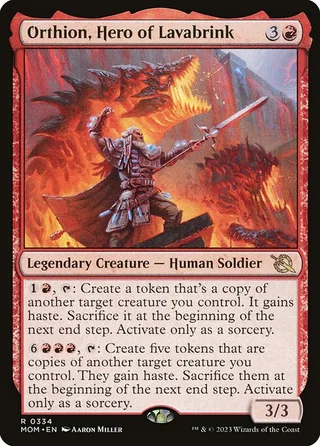
One copy now, with five as a late-game option.
Orthion's smaller activation gives you one temporary hasty copy of another creature you control. For nine mana, you can get five instead. Both abilities require tapping and work only at sorcery speed, so the large number is a ceiling to build toward rather than an early promise.
A target with a useful entry or attack makes the smaller activation worthwhile while you develop your mana. Haste helps Orthion act sooner, but you still have to fund the copies. Kiki-Jiki is the comparison for repeated utility; Rionya is the comparison for a burst supported by spells. Choose according to how you'll reach that turn.
1,507 EDHREC decks (past two years; October 4, 2026). Oracle text and rulings. Compare singles printings and prices.
Shop Orthion, Hero of Lavabrink6. Delina, Wild Mage
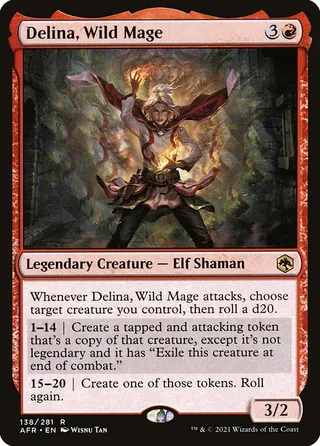
Roll for more copies, but build for the ordinary result.
When Delina attacks, she copies one of your creatures as a tapped-and-attacking nonlegendary token. A high die roll lets you roll again, so some attacks can produce much more than others. Those tokens weren't declared as attackers, which means entering attacking doesn't trigger their own attack-declaration abilities.
Entry and combat-damage abilities make better targets for that reason. One copy is the normal minimum to build around; a lucky run of rolls is a bonus. Delina suits a group that enjoys dice and uneven turns. That possibility of a big turn isn't a dependable infinite combo or evidence for a particular chance of winning.
2,730 EDHREC decks (past two years; October 4, 2026). Oracle text and rulings. Compare singles printings and prices.
Shop Delina, Wild Mage7. Calamity, Galloping Inferno
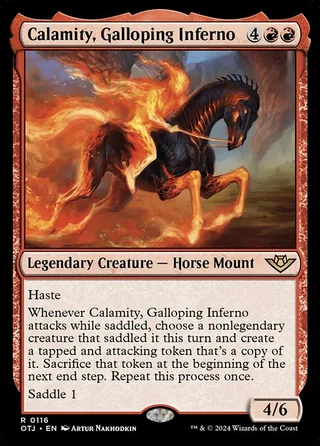
Your saddler can become two attacking copies.
Calamity needs to attack while saddled. The trigger makes a tapped-and-attacking copy of a nonlegendary creature that saddled it that turn, then repeats the process. You can choose that same creature again or a different eligible saddler for the second copy. A good entry ability can pay off even if neither token gets through blockers.
You have to saddle Calamity first, and the creature you copy has to meet that restriction. The tokens enter attacking rather than being declared as attackers, so they won't produce their own attack-declaration triggers. This is a creature-focused combat burst; a legendary payoff beside Calamity won't automatically be a valid copy choice.
1,815 EDHREC decks (past two years; October 4, 2026). Oracle text and rulings. Compare singles printings and prices.
Shop Calamity, Galloping Inferno8. Gogo, Mysterious Mime
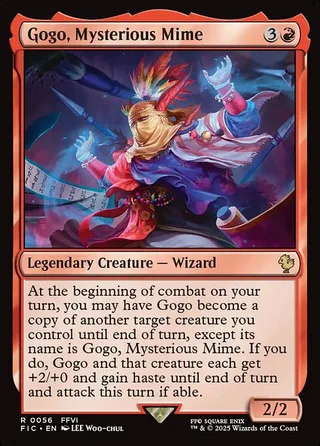
Borrow another creature's abilities for the attack.
At the beginning of your combat, Gogo can become a copy of another creature you control until the turn ends while keeping its name. Both creatures get extra power and haste and must attack if able. You're changing Gogo, not making a new creature enter the battlefield.
That difference makes attack and combat-damage abilities more appealing than entry-only effects. Your original creature also needs to survive until combat, and both creatures may have to make awkward attacks. Gogo gives you an adaptable second threat. Rionya is the better direction if you specifically want several new creatures entering.
985 EDHREC decks (past two years; October 4, 2026). Oracle text and rulings. Compare singles printings and prices.
Shop Gogo, Mysterious MimeMono-red theme
Best Mono-Red Commanders for Dragons and flying threats
Lathliss grows a permanent Dragon army as you play more Dragons. Zirilan finds the particular Dragon you need for a short visit, while Sarkhan gives you an earlier start.
1. Lathliss, Dragon Queen
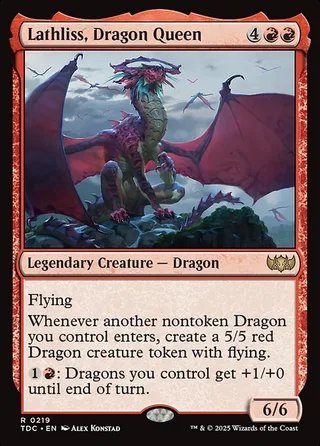
Each real Dragon brings another flying 5/5.
Lathliss makes a flying 5/5 Dragon token whenever another nontoken Dragon enters under your control. Casting Dragons, putting them straight into play or bringing them back can all grow the army. Her pump ability gives that wide flying board a way to hit harder when it's time to attack.
She's our straightforward Dragon-tribal recommendation, but she supplies bodies rather than the mana to cast them. Ramp and draw keep an expensive creature curve moving. Token copies don't satisfy her nontoken condition, so they won't make another Dragon through Lathliss. That's worth checking before you build around a tempting token interaction.
4,440 EDHREC decks (past two years; October 4, 2026). Oracle text and rulings. Compare singles printings and prices.
Shop Lathliss, Dragon Queen2. Sarkhan, Dragon Ascendant
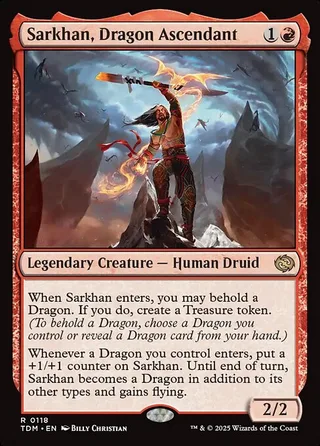
A Dragon commander you can deploy before the big threats.
Sarkhan can make a Treasure on entry if you behold a Dragon. When your Dragons enter, he gains counters and temporarily becomes a flying Dragon himself. The early Treasure and growing power give you something useful to do before the most expensive creatures arrive.
Choose him when the opening curve matters more than getting Lathliss's extra Dragons. Changing his type doesn't make him enter again, and one Treasure won't fund the whole deck. Lathliss grows your flying army; Zirilan finds a particular Dragon. Sarkhan offers the earlier start between those more expensive plans.
1,417 EDHREC decks (past two years; October 4, 2026). Oracle text and rulings. Compare singles printings and prices.
Shop Sarkhan, Dragon Ascendant3. Zirilan of the Claw
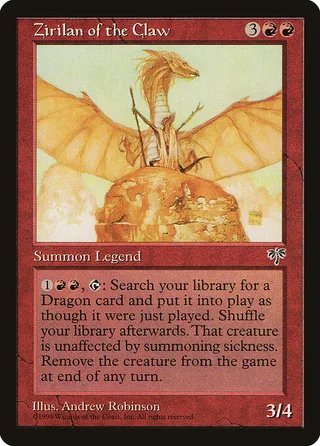
Find the Dragon that answers this particular board.
Zirilan searches a Dragon permanent onto the battlefield with haste, then exiles it at the next end step. You can pick an entry ability for the situation or get an immediate attack. That choice is the reason to play him, though each activation still takes mana and a tap.
The Dragon's stay is temporary, so think about what it can accomplish before exile. A sacrifice outlet can move it to the graveyard for another recovery plan, but you'll need that extra card. Zirilan is the toolbox choice. Lathliss is easier to build when what you want is a permanent army of flying attackers.
910 EDHREC decks (past two years; October 4, 2026). Oracle text and rulings. Compare singles printings and prices.
Shop Zirilan of the Claw4. Themberchaud
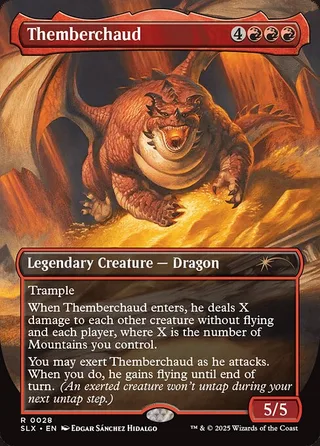
More Mountains mean a bigger blast, including damage to you.
Themberchaud's entry damages each player and every other nonflying creature according to your Mountain count. It can clear your own support creatures and lower your life total too. Exerting gives it flying for an attack, at the price of skipping its next normal untap.
This is an expensive, Mountain-heavy project. Count Mountains rather than all your lands, and look at your life total and creatures before reusing the entry ability. The deck needs a finish that survives its own damage. Themberchaud offers a large immediate effect, but it isn't a general-purpose Dragon engine.
1,947 EDHREC decks (past two years; October 4, 2026). Oracle text and rulings. Compare singles printings and prices.
Shop Themberchaud5. Fin Fang Foom
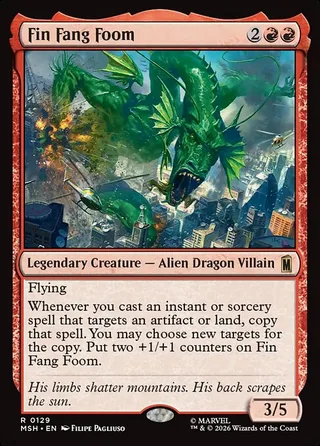
Artifact and land spells get a second copy.
Fin Fang Foom copies an instant or sorcery you cast when it targets an artifact or land, and gains counters. You can choose new targets for the copy. That gives qualifying removal and utility spells extra value and the Dragon a purpose beyond being a large flying threat.
You'll want enough of those spells to use the ability regularly. Creature-targeted burn won't do the job. Doubling artifact removal and copying land destruction can also produce very different games. Tell the other players if repeated land destruction is part of your plan; calling the deck Dragon tribal doesn't explain that choice.
850 EDHREC decks (past two years; October 4, 2026). Oracle text and rulings. Compare singles printings and prices.
Shop Fin Fang Foom6. Inferno of the Star Mounts
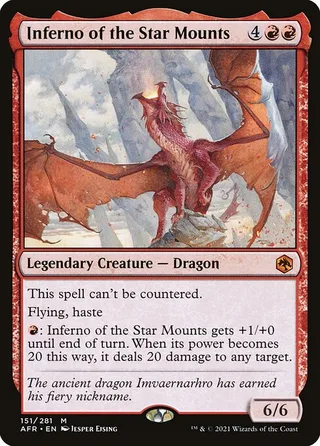
Count each pump on the way to exactly twenty power.
Inferno can't be countered and has flying and haste, giving you an immediate attack once it resolves. Its red pump ability has an extra damage effect when that ability makes its power become exactly twenty. Having twenty power from some other event doesn't satisfy the same condition.
This is a commander-combat-damage deck and a place to spend lots of mana, rather than a Dragon draw engine. Other power bonuses change how many activations you'll need, so count from the actual starting point. Being uncounterable won't protect Inferno from removal after it resolves. Haste gives you an earlier chance to attack, not immunity.
1,494 EDHREC decks (past two years; October 4, 2026). Oracle text and rulings. Compare singles printings and prices.
Shop Inferno of the Star MountsMono-red theme
Best Mono-Red Commanders for Large creatures and haste
These commanders help large creatures do something sooner. Some let you cast them for less; others borrow them from your hand. The difference matters when your creatures have cast or attack triggers.
1. Herigast, Erupting Nullkite
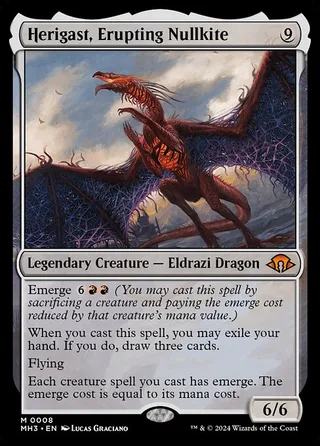
Use one useful creature to help pay for the next.
Herigast has emerge and gives emerge to your other creature spells. Sacrificing a creature with a substantial mana value can reduce the generic cost of the next one. Herigast's own cast trigger can also exchange an unwanted hand for three cards, helping a creature-heavy deck keep moving.
You'll still pay colored costs, and the sacrificed creature is a real loss unless its entry or death already helped you. Normal mana development matters too. If Herigast is removed, expensive creatures can pile up in hand without the discount. Creatures worth playing on their own make that risk easier to manage.
5,034 EDHREC decks (past two years; October 4, 2026). Oracle text and rulings. Compare singles printings and prices.
Shop Herigast, Erupting Nullkite2. Purphoros, Bronze-Blooded
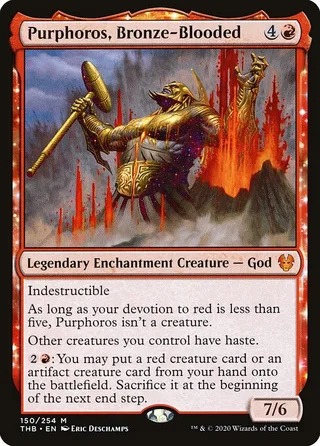
Give your creatures haste and borrow a large threat from hand.
Bronze-Blooded gives your other creatures haste. His activation puts a red creature or artifact creature from your hand onto the battlefield for a temporary stay. An entry effect or immediate attack can make the payment worthwhile even though you'll sacrifice the creature later.
You need draw and worthwhile creatures in hand to keep doing it. The ability isn't casting the creature and doesn't search for one, so it won't solve an empty hand. This Purphoros helps deploy large creatures. God of the Forge is the different Purphoros to choose when you want repeated small token entries to damage everyone.
1,361 EDHREC decks (past two years; October 4, 2026). Oracle text and rulings. Compare singles printings and prices.
Shop Purphoros, Bronze-Blooded3. Ilharg, the Raze-Boar
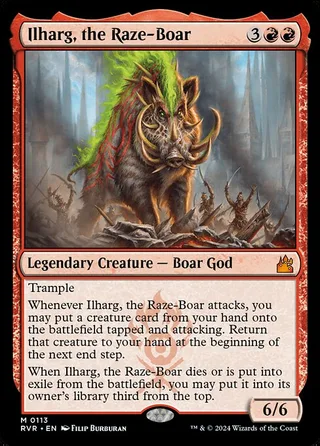
An attack puts the expensive creature in your hand to work.
Ilharg attacks and puts a creature from your hand onto the battlefield tapped and attacking. It returns to your hand at the next end step, ready to be borrowed again on a later attack. You bypass the casting cost and can reuse entry effects, though the creature wasn't declared as an attacker.
That makes entry and combat-damage abilities better choices than attack-declaration abilities. Ilharg needs an attack he can survive, and haste helps him get the first one. Draw and independent threats matter if repeated removal makes him too expensive to recast. Otherwise, those large creatures may sit in hand with no affordable way onto the battlefield.
1,213 EDHREC decks (past two years; October 4, 2026). Oracle text and rulings. Compare singles printings and prices.
Shop Ilharg, the Raze-Boar4. Tannuk, Steadfast Second
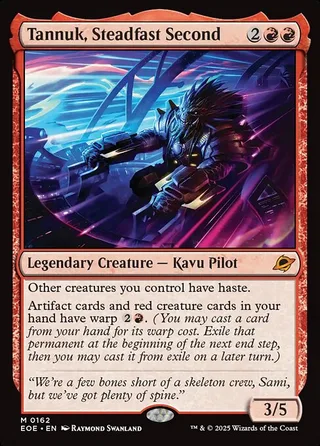
Pay for a short first visit, then cast the card again later.
Tannuk gives your other creatures haste and offers warp to artifacts and red creatures in your hand. A warped permanent goes into exile at the next end step, and you can cast it from there on a later turn. That gives an entry effect or attacker an early visit before a normal deployment.
The first payment needs to accomplish something worthwhile. Warp isn't a permanent discount, and the later cast isn't free. You'll need mana for both stages. It also is casting the card, unlike an ability that simply puts a creature onto the battlefield. That distinction matters if the rest of your deck rewards casts.
10,330 EDHREC decks (past two years; October 4, 2026). Oracle text and rulings. Compare singles printings and prices.
Shop Tannuk, Steadfast Second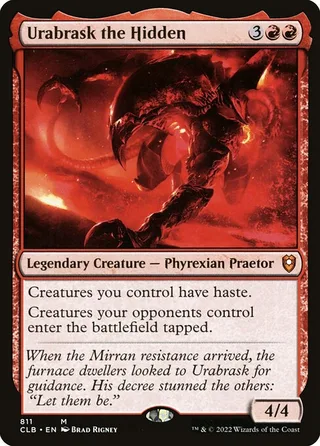
Mono-red theme
Best Mono-Red Commanders for Exile cards and impulse access
Laelia finds another card when she attacks. The other choices offer wider reveals, borrowed spells or damage from cards you leave unused. Watch how long you have to play what you find.
1. Laelia, the Blade Reforged
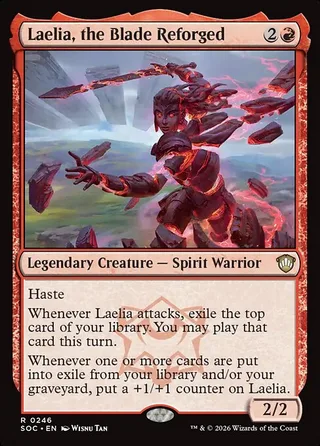
Attack early, see another card and grow with exile.
Laelia has haste and exiles a card you can play that turn when she attacks. She also gains a counter when cards leave your library or graveyard for exile. It's the qualifying event that counts: exiling several cards together doesn't give a separate counter for every card.
She's our low-curve starting choice for exile and combat. Leave mana, and ideally a land play, available to use the attack's reveal. Those cards aren't waiting safely in hand if you can't use them. Protection or evasion helps the growing Laelia remain a threat as opposing boards become harder to attack.
2,241 EDHREC decks (past two years; October 4, 2026). Oracle text and rulings. Compare singles printings and prices.
Shop Laelia, the Blade Reforged2. Dragonhawk, Fate's Tempest
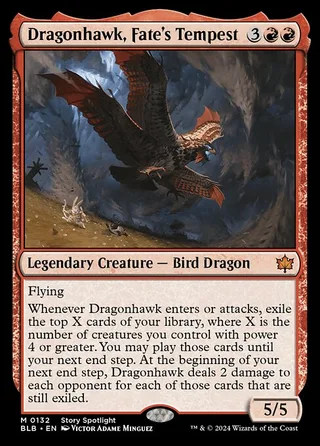
Use the revealed cards, or let the leftovers deal damage.
Dragonhawk's entry and attack abilities look at cards according to how many creatures with power four or greater you control. You can play the cards until your next end step. Any still exiled then damage every opponent, so spending the cards and leaving them for damage can both help you.
Count qualifying creatures, not their combined power. Enough mana gives you a real choice when a worthwhile card appears, and the exact end step determines when you lose that choice. Dragonhawk works in a wider large-creature deck. You don't have to make it Dragon tribal to benefit from the ability.
2,668 EDHREC decks (past two years; October 4, 2026). Oracle text and rulings. Compare singles printings and prices.
Shop Dragonhawk, Fate's Tempest3. Etali, Primal Storm
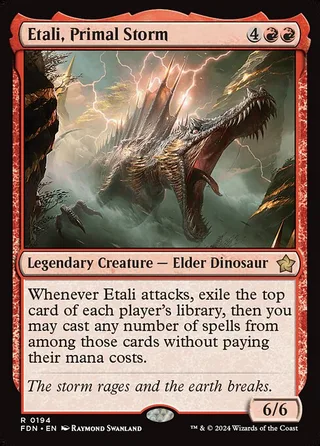
Attack and borrow free spells from everyone's library.
Primal Storm exiles the top card of each player's library when it attacks and lets you cast the spells without paying their mana costs. Lands aren't spells, so you can't cast them through this ability. At six mana, Etali particularly appreciates haste: without it, opponents have a turn to remove your investment before it does anything.
This is the mono-red Etali. Primal Conqueror has red-green identity and belongs in a different guide. Primal Storm offers high-variance big turns, but removal makes each recast costly. Ramp, protection and your own useful spells are more dependable than assuming another player's library will always supply the answer or finish you need.
2,426 EDHREC decks (past two years; October 4, 2026). Oracle text and rulings. Compare singles printings and prices.
Shop Etali, Primal Storm4. Plargg and Nassari
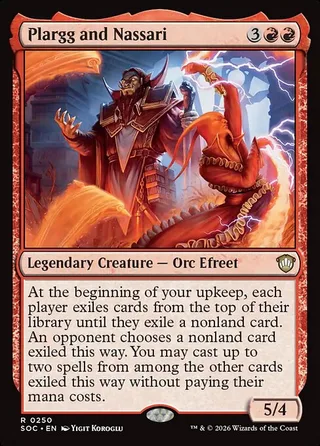
Two free spells, after an opponent removes one option.
At your upkeep, each player exiles cards until reaching a nonland card. An opponent removes one of those options from consideration, and you may cast up to two of the others for free. Plargg and Nassari don't have to attack, but they do have to survive until that upkeep.
The veto is part of the bargain. You shouldn't expect to get the most threatening revealed card just because it's there. This commander fits repeated borrowed value with an opponent making a meaningful choice. Protection and your own answers keep the deck working when the free spells aren't the ones the situation calls for.
1,398 EDHREC decks (past two years; October 4, 2026). Oracle text and rulings. Compare singles printings and prices.
Shop Plargg and Nassari5. Rose, Cutthroat Raider
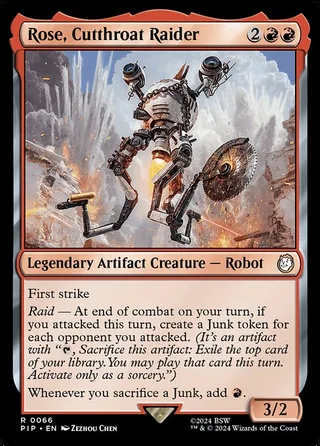
Attack more opponents to get more Junk.
Rose's raid ability makes a Junk for each opponent you attacked. That rewards spreading your attacks rather than putting everything into one hit, and combat damage isn't required. Junk gives sorcery-speed temporary card access; sacrificing it also makes red mana through Rose to help use what you uncover.
You need several attackers and enough mana for the revealed cards. Sending creatures into bad blocks may earn Junk but cost the army that gets you more next turn. Rose is the wider-board alternative to Laelia, with artifact tokens and sacrifice interactions giving you another reason to prefer her.
977 EDHREC decks (past two years; October 4, 2026). Oracle text and rulings. Compare singles printings and prices.
Shop Rose, Cutthroat Raider6. Nico Minoru, Runaway
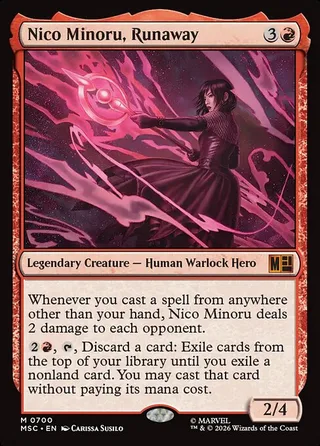
Exile and graveyard casts turn into damage for everyone.
Nico damages each opponent when you cast a spell from somewhere other than your hand. Exile and graveyard casts work when another effect gives you permission. Her own activated ability spends a card and mana to find a nonland spell in the library, giving the damage plan somewhere to start.
The activation requires tapping, and it won't make an arbitrary chain infinite. A spell copy that wasn't cast also won't trigger the damage. You'll want enough genuine outside-hand casting to keep Nico useful, plus spells that do a worthwhile job when she's absent. The damage is the reward for that casting plan, not a substitute for it.
681 EDHREC decks (past two years; October 4, 2026). Oracle text and rulings. Compare singles printings and prices.
Shop Nico Minoru, Runaway7. Urabrask, Heretic Praetor
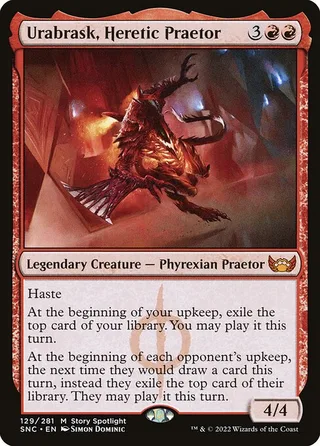
More options for you, less convenient timing for opponents.
Heretic Praetor gives you an extra exiled card to play at the beginning of your upkeep. It also replaces each opponent's next draw that turn with temporary exile access. That can force awkward choices about when to use a card, while haste gives Urabrask himself immediate combat pressure.
The opposing effect isn't a complete draw lock. It changes the next draw, and the card can still be played during its allowed window. Choose this Urabrask for sustained pressure and that timing disruption. Laelia costs less and focuses more directly on finding and using your own exiled cards.
611 EDHREC decks (past two years; October 4, 2026). Oracle text and rulings. Compare singles printings and prices.
Shop Urabrask, Heretic Praetor8. Norin, Swift Survivalist
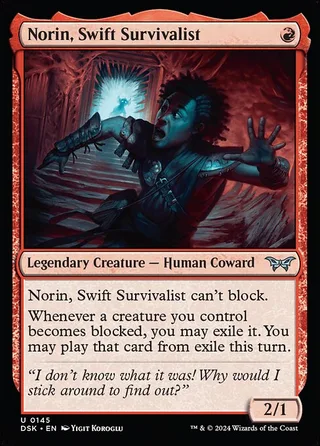
A blocked creature can leave and be played again that turn.
Swift Survivalist lets you exile your creature when it becomes blocked, then gives you permission to play it that turn. A useful entry effect can make replaying the creature better than losing it in combat. The creature doesn't return for free, though, and Norin himself can't block.
You need the mana to replay what you save. If the creature is too expensive to use that turn, exiling it can leave you with less on the battlefield instead of a better position. This Norin is a combat-and-entry specialist. The original Norin's automatic delayed return is a different engine.
1,581 EDHREC decks (past two years; October 4, 2026). Oracle text and rulings. Compare singles printings and prices.
Shop Norin, Swift SurvivalistMono-red theme
Best Mono-Red Commanders for Equipment and targeted-spell combat
Godo finds an exact Equipment, Gilgamesh can put several into play, and Valduk turns attachments into an army. Pick the result you want before buying the pieces.
1. Godo, Bandit Warlord
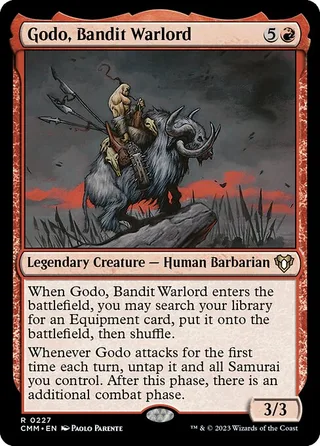
Find an Equipment, with a faster combo available if you want it.
Godo puts an Equipment from your library onto the battlefield when he enters. His first attack each turn untaps him and your Samurai and adds a combat; it does not untap your whole attacking army. That's useful in an ordinary Equipment deck. Helm of the Host offers a much faster route when you have assembled its token and combat sequence correctly.
Finding Helm isn't the whole payment. You still have to attach it and begin the sequence. Tell the other players if you're bringing that optimized combo rather than an Equipment toolbox. The cEDH section gives dated event results for Godo, without treating every deck with him as tournament-ready.
1,891 EDHREC decks (past two years; October 4, 2026). Oracle text and rulings. Compare singles printings and prices.
Shop Godo, Bandit Warlord2. Gilgamesh, Master-at-Arms
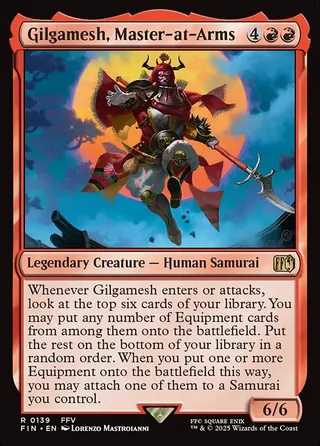
Put several Equipment into play, then attach one.
Gilgamesh looks at six cards when he enters or attacks and can put all the Equipment among them onto the battlefield. If any enters that way, you can attach one to a Samurai you control. Finding several pieces is the appeal, but the ability won't attach all of them for you.
Equipment density helps the reveal, while creatures and interaction still need room in the deck. Samurai targets and the remaining equip costs determine how quickly the new pieces become useful. Gilgamesh is the choice for a broad Equipment board. Godo is better when you need one exact piece from the library.
3,113 EDHREC decks (past two years; October 4, 2026). Oracle text and rulings. Compare singles printings and prices.
Shop Gilgamesh, Master-at-Arms3. Valduk, Keeper of the Flame
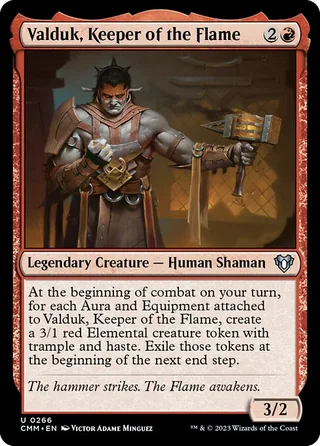
Every attachment helps make another attacker.
At the beginning of your combat, Valduk makes a hasty, trampling 3/1 Elemental for each Aura and Equipment attached to him. Cheap attachments can therefore give you bodies as well as their usual bonuses. The tokens disappear at the next end step, so immediate attacks or a sacrifice outlet give them their value.
This is a go-wide deck even though you're putting the attachments on one creature. Equip before the combat trigger, and use draw to keep the supply coming. Removing Valduk stops the token engine. Attachments and other creatures that remain useful without him help you recover instead of leave a collection of idle pieces.
2,636 EDHREC decks (past two years; October 4, 2026). Oracle text and rulings. Compare singles printings and prices.
Shop Valduk, Keeper of the Flame4. Firion, Wild Rose Warrior
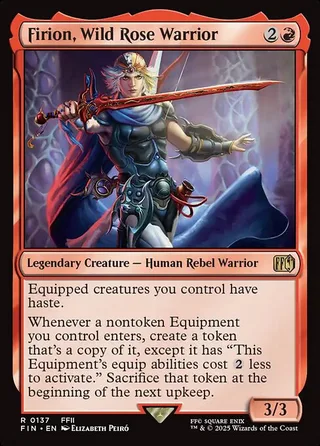
One Equipment can serve two attackers for a short time.
Firion gives your equipped creatures haste and copies each nontoken Equipment that enters under your control. The copy has cheaper equip abilities and lasts until the next upkeep. That lets a useful Equipment cover a second attacker for one combat cycle.
You still pay to attach the original and cover any remaining equip cost on the copy. Efficient Equipment and a team worth equipping make more sense than filling the deck with expensive pieces. Token Equipment won't retrigger the nontoken condition, so the copy doesn't automatically produce another copy forever.
844 EDHREC decks (past two years; October 4, 2026). Oracle text and rulings. Compare singles printings and prices.
Shop Firion, Wild Rose Warrior5. Freya Crescent
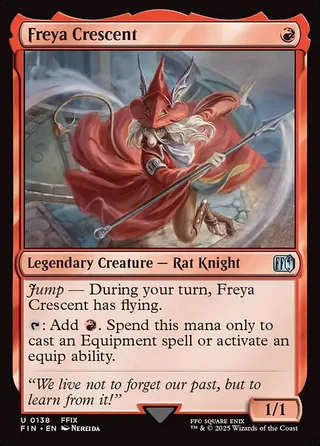
A little help paying for Equipment and equip costs.
Freya taps for red mana that can pay for Equipment spells or equip abilities. She also has flying during your turn, which can help an equipped attack. Those are competing uses unless another effect helps: tapping her for mana won't leave her ready to attack. The mana can't pay for an unrelated instant or creature.
She's a specialist starting direction for an Equipment build, rather than a tutor or draw engine. You'll need a worthwhile curve and separate card access. Godo finds the exact Equipment you need; Valduk makes more creatures from attachments. Freya helps pay for the equipment plan you already have.
707 EDHREC decks (past two years; October 4, 2026). Oracle text and rulings. Compare singles printings and prices.
Shop Freya Crescent6. Rosnakht, Heir of Rohgahh
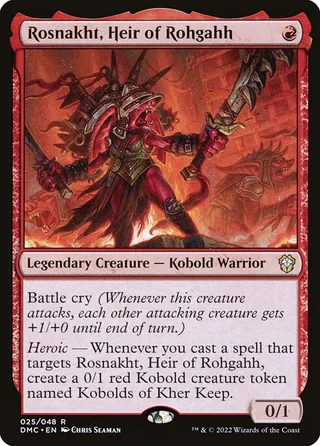
Target Rosnakht to make Kobolds, then attack together.
Rosnakht makes a Kobold when you cast a spell targeting her. Her own battle cry gives each other attacking creature +1/+0 until end of turn; it does not grant those creatures battle cry. That helps the zero-power Kobolds attack usefully. Cheap targeting spells and a wide board fit together, but copying a spell without casting it won't trigger heroic again.
At one mana, Rosnakht is an inexpensive way to begin that token plan. You'll still need draw and enough pump to turn the army into a finish. Zada has a different attraction: one targeting cantrip can refill your hand when an army is already there. Rosnakht makes bodies from those casts instead.
1,011 EDHREC decks (past two years; October 4, 2026). Oracle text and rulings. Compare singles printings and prices.
Shop Rosnakht, Heir of RohgahhMono-red theme
Best Mono-Red Commanders for Shared combat and punishment
These commanders make combat a shared problem. Some lend their threats, some force attacks and others discourage attacks at you. Explain what the deck does before the game so the other players know what to expect.
1. Alexios, Deimos of Kosmos
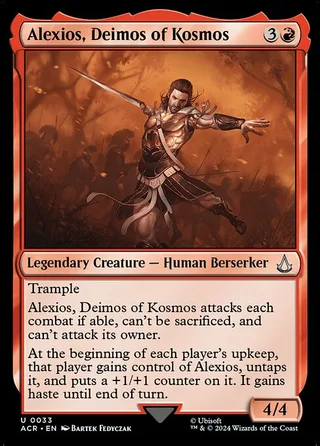
A growing attacker that circulates around the table.
At each player's upkeep, Alexios changes controller, untaps and gains a counter. He must attack if able, can't attack his owner and can't be sacrificed. Equipment and other power support can make him dangerous as he travels, without you repeatedly casting new attackers.
You're still his owner when another player controls him, and his commander combat damage still belongs to that same commander. You also still have to deal with other attackers, noncombat effects and removal. Alexios changes the combat decisions around the table; his owner restriction doesn't make you safe from everything else happening in the game.
8,927 EDHREC decks (past two years; October 4, 2026). Oracle text and rulings. Compare singles printings and prices.
Shop Alexios, Deimos of Kosmos2. Slicer, Hired Muscle
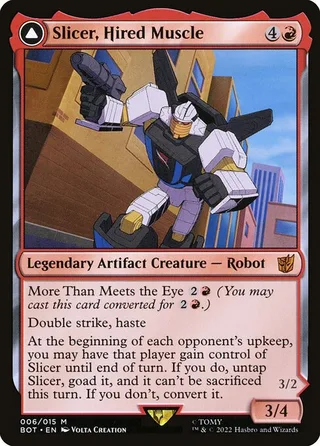
Let other players add to your commander's combat damage.
Slicer can be cast converted for an alternative cost and changes faces through its own combat ability. On opponents' upkeeps, the front face can be lent to that player, untapped and goaded, with protection from sacrifice for the turn. Lending a double-striking commander can build combat-damage pressure quickly.
Both faces and the control windows matter. The sacrifice protection doesn't stop every kind of removal, and goad becomes less helpful when only one opponent remains. A casual deck built around lending Slicer and an optimized tournament build make different demands. The evidence section keeps those possibilities separate rather than use one to prove the other.
5,255 EDHREC decks (past two years; October 4, 2026). Oracle text and rulings. Compare singles printings and prices.
Shop Slicer, Hired Muscle3. Khârn the Betrayer
Give away the dangerous creature and draw two cards.
Khârn must attack or block if able. When damage to him is prevented, you pass him to an opponent you choose; losing control draws you two cards. The deck gets its cards by making those exchanges, rather than by keeping the large attacker entirely for itself.
You remain the owner, but the opponent receiving Khârn can attack with him. A safe way to initiate the exchange and useful plays for the cards you draw make the plan worthwhile. His damage prevention won't stop exile, sacrifice or a toughness reduction that doesn't deal damage. Those answers can end the exchange engine.
2,090 EDHREC decks (past two years; October 4, 2026). Oracle text and rulings. Compare singles printings and prices.
Shop Khârn the Betrayer4. Kratos, God of War
The whole table gets faster, and idle creatures cost life.
Kratos gives haste to all creatures, not only yours. At each player's end step, he damages that player according to their creatures that didn't attack. Double strike helps his own attacks, while the global abilities encourage everyone to commit creatures sooner. A defensive token pile can become expensive to keep at home.
Tell the other players what the deck does before starting, because this speeds up their creatures too. Your fresh creatures face the same pressure, and opposing hasty threats can punish a weak defense. A combat finish and interaction give you a reason to want that faster game; forcing attacks doesn't always favor the person who cast Kratos.
9,559 EDHREC decks (past two years; October 4, 2026). Oracle text and rulings. Compare singles printings and prices.
Shop Kratos, God of War5. Varchild, Betrayer of Kjeldor
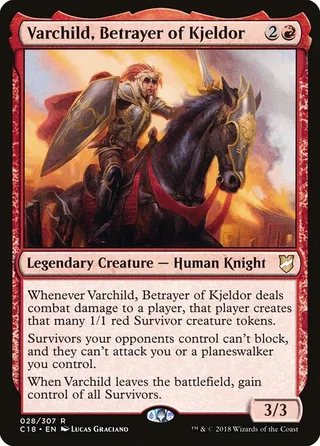
Give an opponent Survivors, then take them when Varchild leaves.
Varchild's combat damage gives the damaged player Survivor tokens. While you control her, opposing Survivors can't block or attack you or your planeswalkers. That restriction ends when Varchild leaves. Her separate leave trigger gives you control of all Survivors once it resolves, turning successful attacks into a later army.
Until then, the tokens can attack other players. You need to help Varchild connect and have a use for the army when it comes over. Removing her ends the restriction before the control trigger resolves, so those are separate events. She's the delayed, political token choice; Krenko gives you your own bodies more directly.
995 EDHREC decks (past two years; October 4, 2026). Oracle text and rulings. Compare singles printings and prices.
Shop Varchild, Betrayer of Kjeldor6. Fumiko the Lowblood
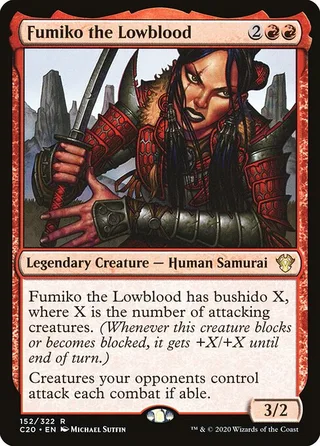
Opposing creatures have to attack, but they can still choose you.
Fumiko makes opposing creatures attack if able. Her bushido bonus grows with the number of attacking creatures, which can make combat involving her awkward. She doesn't tell opponents to attack somebody else, though. They still choose among the legal destinations for those attacks.
Defensive support gives you a way to handle the attacks you provoke. You'll also need a finish, because mandatory combat isn't protection by itself. Fumiko suits combat manipulation across the table. Kazuul is the more direct comparison if you want a commander that makes attacks specifically against you costly.
536 EDHREC decks (past two years; October 4, 2026). Oracle text and rulings. Compare singles printings and prices.
Shop Fumiko the Lowblood7. Kazuul, Tyrant of the Cliffs
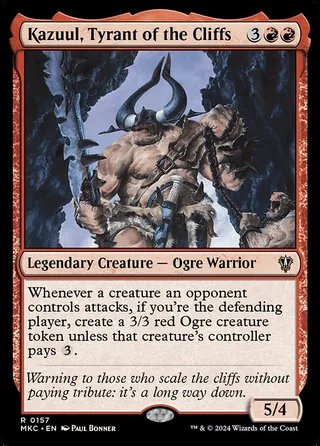
An opponent's attack can pay for your next Ogre.
Kazuul triggers for each opposing creature attacking you, a planeswalker you control or a battle you protect. Its controller can pay three mana; otherwise, you make a 3/3 Ogre. That gives wide attacks an extra cost and can supply blockers or future attackers. Attacks at someone else won't help you.
The opponent gets the choice. A player with spare mana can pay, and evasive creatures can still get through. Kazuul is useful defense, but he isn't a token factory you can switch on yourself. Draw, removal and a finish keep your deck doing something when opponents decide to leave you alone.
894 EDHREC decks (past two years; October 4, 2026). Oracle text and rulings. Compare singles printings and prices.
Shop Kazuul, Tyrant of the Cliffs8. Zo-Zu the Punisher
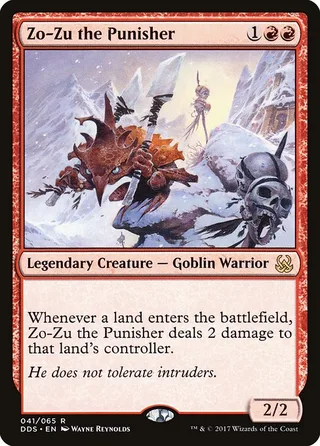
Every land comes with two damage, even yours.
Zo-Zu deals two damage to the controller of each land that enters. A ramp spell bringing in several lands can be painful, but your own ordinary land drop costs life too. The ability applies to both, without deciding whether a player's land development is fair.
This is a punishment deck, so tell the other players before the game. You'll need to account for your own life loss and have a way to finish instead of simply slow everyone down. Zo-Zu also won't answer a player who can win without putting more lands onto the battlefield. Interaction still has a job.
2,813 EDHREC decks (past two years; October 4, 2026). Oracle text and rulings. Compare singles printings and prices.
Shop Zo-Zu the PunisherMono-red theme
Best Mono-Red Commanders for Combat mana and lands
Neheb pays you after combat. Roku, Zuko and Tesak supply mana you need to spend during it. Moraug and Zell take a different route, using land plays to support more attacks.
1. Neheb, the Eternal
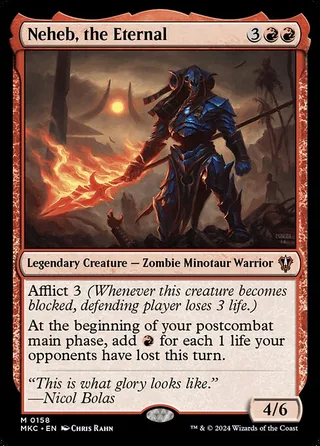
Deal damage first and spend the mana after combat.
When each of your postcombat main phases begins, Neheb makes red mana equal to all the life your opponents lost that turn. Combat, burn and other life loss can contribute. It isn't limited to damage Neheb dealt himself. An early damage spell can therefore pay you back with a much larger spell later that turn.
The life loss has to happen before the relevant trigger, and you'll want spells worth spending that mana on. An extra-combat combination only gives more mana if another postcombat main phase actually occurs. Neheb is a useful damage-to-mana engine with that support; without dependable life loss, the five-mana commander can do very little.
4,019 EDHREC decks (past two years; October 4, 2026). Oracle text and rulings. Compare singles printings and prices.
Shop Neheb, the Eternal2. Avatar Roku, Firebender
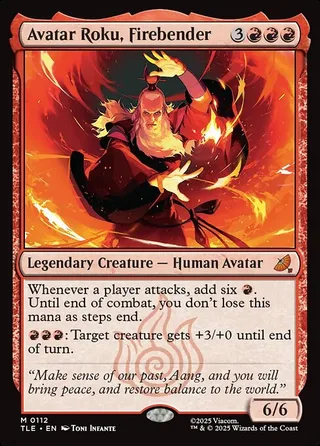
A burst of red mana whenever anyone attacks.
Roku makes six red mana whenever a player attacks, including on other players' turns. It stays available through the steps of that combat, then ends with the combat. His pump ability gives you one way to spend it. Instants and other legal combat activations can use the burst as well.
That mana won't wait for your normal main phase. The deck needs plays you can make during combat, and pumping an opposing creature can make your own defense worse. Roku suits a reactive combat plan. Neheb instead gives you postcombat mana for large sorceries and other main-phase plays.
2,138 EDHREC decks (past two years; October 4, 2026). Oracle text and rulings. Compare singles printings and prices.
Shop Avatar Roku, Firebender3. Zuko, Firebending Master
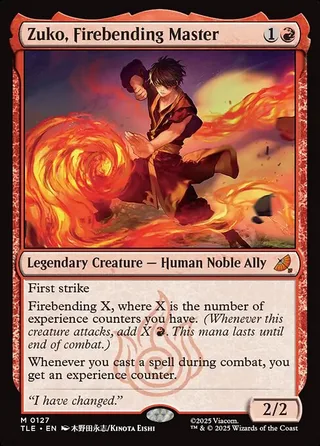
Combat spells grow the mana available on later attacks.
Zuko gives you an experience counter when you cast a spell during combat. His firebending adds red mana on attack equal to your experience count. You keep those counters even if he's removed. The count starts at zero, though, so your first combat may need another mana source to get the process going.
You need spells you can cast during combat and ways to use the red mana there. It isn't unrestricted main-phase ramp. First strike helps Zuko attack, while protection helps him keep supplying mana. Useful spells that don't depend entirely on his presence make the deck less fragile when opponents remove him.
1,746 EDHREC decks (past two years; October 4, 2026). Oracle text and rulings. Compare singles printings and prices.
Shop Zuko, Firebending Master4. Tesak, Judith's Hellhound
A wide attack makes more red mana to spend during combat.
When Tesak attacks, he makes red mana for every attacking creature. His counter-based haste and the unleash he gives Dogs can help build that attack. Accepting an unleash counter also prevents that creature from blocking, so the extra aggression has a defensive cost.
The mana arrives during combat and won't automatically survive into your next main phase. You'll want useful ways to spend it while the attack is happening. Dogs can support the theme, but draw, interaction and other good attackers still deserve space. Tesak works best when the whole attack, not just the creature type, has a purpose.
830 EDHREC decks (past two years; October 4, 2026). Oracle text and rulings. Compare singles printings and prices.
Shop Tesak, Judith's Hellhound5. Moraug, Fury of Akoum
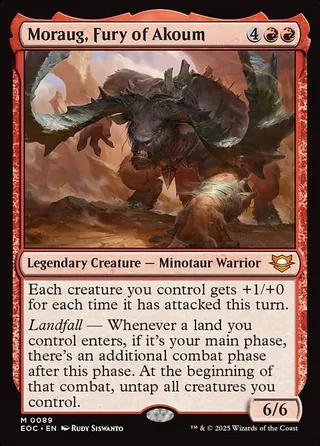
Time your land plays to get useful extra combats.
Moraug's landfall gives you another combat when a land enters during your main phase. Your creatures untap at the start of those added combats and get more power according to how often they've attacked that turn. Where you play the land determines where the new combat appears.
A land before your ordinary combat doesn't promise another untap when that ordinary combat starts. Postcombat landfall can make the phase sequence easier to use. You'll need enough land access to support it either way. At six mana, Moraug is the finisher for that plan, rather than a commander that finds the lands himself.
797 EDHREC decks (past two years; October 4, 2026). Oracle text and rulings. Compare singles printings and prices.
Shop Moraug, Fury of Akoum6. Zell Dincht
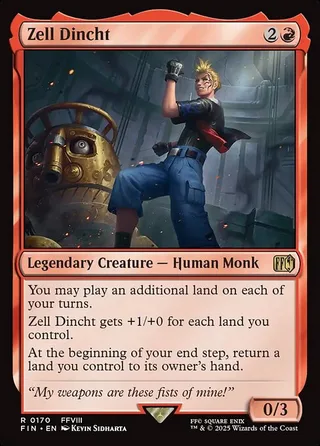
Play another land, then bring one back to hand.
Zell allows an extra land play each turn and gains power from your land count. At your end step, he returns one of your lands to your hand. That can let you replay a useful land for another entry effect, but it also means two land plays aren't simply two lasting additions to the board.
You need lands in hand to use the permission and a reason to welcome the return. It's an unusual mono-red way to support land-based combat, not unrestricted green-style acceleration. Moraug is the comparison for the combat payoff. Zell doesn't draw the lands himself, so card access remains part of the deck.
1,185 EDHREC decks (past two years; October 4, 2026). Oracle text and rulings. Compare singles printings and prices.
Shop Zell DinchtMono-red theme
Best Mono-Red Commanders for Discard, self-damage and recurring threats
These decks get something useful from damage you take, cards you discard or cards leaving your graveyard. Match your support to the actual event: paying life is not damage, and filtering a card is not drawing an extra one.
1. Auntie Blyte, Bad Influence
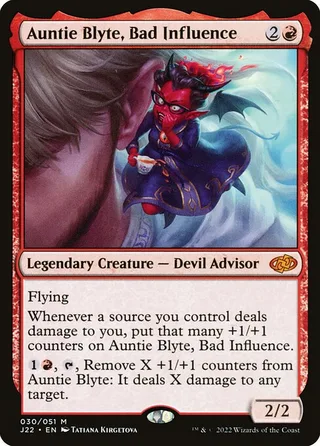
Damage to you can make her stronger, if you survive it.
Auntie Blyte gains counters when a source you control damages you. Those counters grow her flying body, or you can spend them with her tap ability to damage any target. Paying life isn't damage, so a life-payment cost won't feed the trigger just because your life total went down.
Controlled self-damage and staying alive are the two sides of this build. Spending all the counters leaves a smaller creature, and tapping for damage competes with attacking unless another effect helps. Auntie Blyte offers a payoff for the damage you take; she doesn't make that damage harmless.
1,986 EDHREC decks (past two years; October 4, 2026). Oracle text and rulings. Compare singles printings and prices.
Shop Auntie Blyte, Bad Influence2. Daredevil, Fearless Fighter
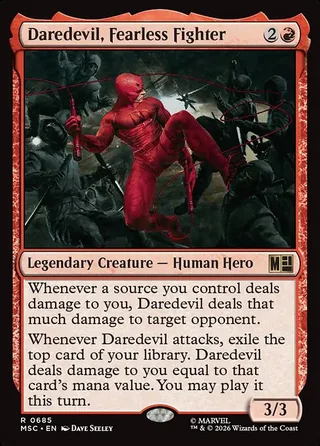
The damage you take can reach an opponent too.
Daredevil damages one opponent when a source you control damages you. His attack also exiles a card you can play that turn and hurts you according to its mana value. That gives the self-damage plan a way to find more cards and produce its own qualifying event.
You still take the original damage. An expensive reveal can be dangerous, so the curve, your life total and the mana left to play the card all matter. Prevention can also stop the event your payoff needs. Life payment isn't damage, and Daredevil's ability hits one opponent rather than spreading it around the whole table.
1,489 EDHREC decks (past two years; October 4, 2026). Oracle text and rulings. Compare singles printings and prices.
Shop Daredevil, Fearless Fighter3. Ashling the Pilgrim
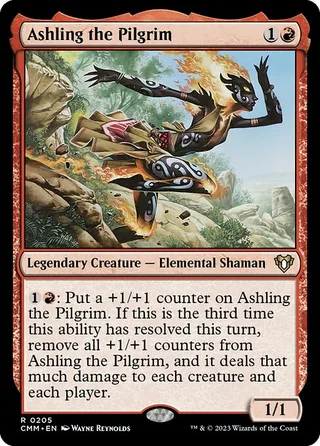
Build counters, then decide when everyone takes the damage.
When Ashling's third activation resolves in a turn, she removes all her counters and deals that much damage to every creature and player. Earlier activations can grow her without releasing it. Stored counters and the timing of that third resolution determine how large the blast becomes.
You'll take the damage too, so calculate your own survival before using the third activation. Protection can help preserve what you need on the battlefield. Auntie Blyte and other self-damage payoffs can benefit, but surviving is still part of the combination. This Ashling is a deliberate mana sink and a symmetric release, not a one-sided sweeper.
2,539 EDHREC decks (past two years; October 4, 2026). Oracle text and rulings. Compare singles printings and prices.
Shop Ashling the Pilgrim4. Ivora, Insatiable Heir
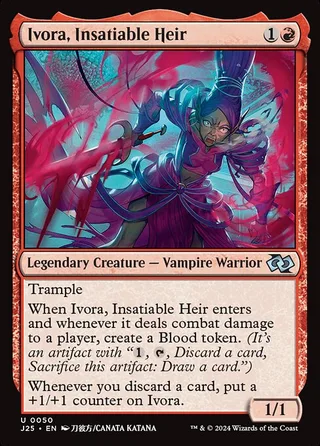
Blood improves your hand while making Ivora larger.
Ivora makes Blood when she enters and when she deals combat damage to a player. She gains a counter whenever you discard a card, giving the Blood a natural role in growing her. Trample helps the larger commander get through for another token.
Using Blood replaces a card rather than adds an extra one. You spend mana, the token and a discarded card to draw one, so independent card advantage still matters. Useful graveyard cards can make the discard more rewarding. Ivora fits discard and combat together; a collection of discard costs without replenishment can simply empty your hand.
985 EDHREC decks (past two years; October 4, 2026). Oracle text and rulings. Compare singles printings and prices.
Shop Ivora, Insatiable Heir5. Inti, Seneschal of the Sun
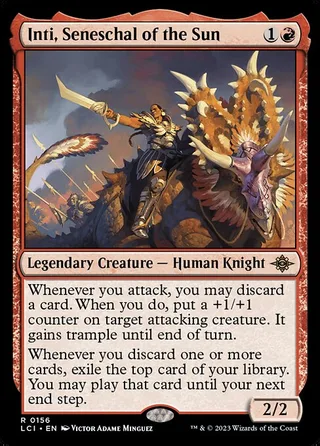
Trade an unwanted card for a better attack and another option.
Inti lets an attack discard a card to put a counter on an attacker and give it trample. A discard event can also exile your top card to play until your next end step. The counter doesn't have to go on Inti, so the abilities can support a wider attacking board.
Leave mana for the exiled card and keep genuine card advantage alongside that filtering. Multiple cards discarded together are one qualifying event for the second ability, not one trigger for each card. The distinction matters if you're expecting a single bulk discard to reveal a whole new hand.
968 EDHREC decks (past two years; October 4, 2026). Oracle text and rulings. Compare singles printings and prices.
Shop Inti, Seneschal of the Sun6. Gau, Feral Youth
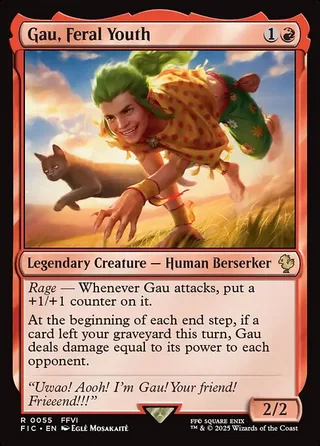
Use your graveyard and let Gau's power supply the damage.
Gau grows when he attacks. At an end step, he damages each opponent if a card left your graveyard that turn, using his power for the amount. Recovering, exiling or casting a card from the graveyard can meet the condition when you have an effect that actually permits it.
Gau doesn't supply that graveyard activity himself. Useful ways to move cards on different turns can produce more end-step opportunities; several exits on one turn don't multiply one end-step trigger. Protecting his growing power makes the damage worthwhile. If you don't want a graveyard package, a more direct burn commander asks less of the rest of the deck.
558 EDHREC decks (past two years; October 4, 2026). Oracle text and rulings. Compare singles printings and prices.
Shop Gau, Feral Youth7. Sabin, Master Monk
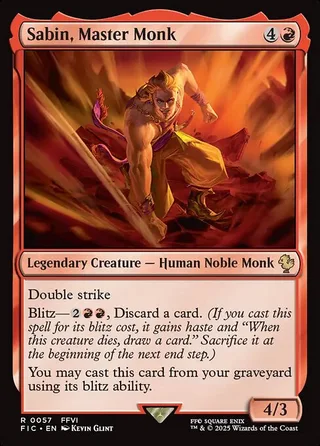
Bring the double-striking attacker back through blitz.
Sabin can be cast from your graveyard with his blitz ability, which requires a discarded card as well as mana. Blitz gives haste, a card when he dies and a delayed sacrifice. With double strike, that creates a way to keep returning a threatening attacker if you can fund each visit.
The death draw helps replace the discard; it doesn't make the mana payment disappear. Graveyard exile stops the replay plan, and blockers still determine how much damage he can deal. Sabin is the choice for recurring combat pressure, rather than a commander that reanimates any creature you happen to want.
530 EDHREC decks (past two years; October 4, 2026). Oracle text and rulings. Compare singles printings and prices.
Shop Sabin, Master Monk8. Squee, the Immortal
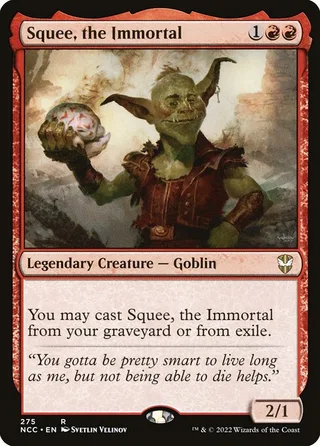
Keep recasting the same creature from graveyard or exile.
Squee can be cast from your graveyard or exile. That permission makes him a repeatable creature for a sacrifice or exile engine. Leaving him outside the command zone can avoid commander tax, but it doesn't reduce his printed casting cost, draw another card or make mana.
The other cards have to pay for each cycle and turn it into something useful. Casting restrictions and payment rules can still interrupt the plan. Squee makes sense for a verified recursion combination. A conventional attacking deck will usually get more help from a commander that supplies extra creatures or cards.
967 EDHREC decks (past two years; October 4, 2026). Oracle text and rulings. Compare singles printings and prices.
Shop Squee, the Immortal9. The Red Terror
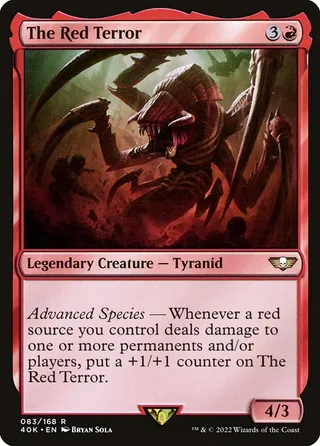
Separate red damage events build a larger threat.
The Red Terror gains a counter when one of your red sources damages one or more permanents or players. Hitting several things in the same event gives one counter. Repeated separate events can grow it much faster, provided the rest of your deck supplies those damage sources.
It's a scaling combat payoff for a deck already doing useful red damage. Evasion, protection and card access help turn the growing body into a finish. Without them, even a large counter pile may sit behind a blocker or disappear to removal before attacking. The commander doesn't create the repeatable damage engine itself.
635 EDHREC decks (past two years; October 4, 2026). Oracle text and rulings. Compare singles printings and prices.
Shop The Red TerrorMono-red theme
Best Mono-Red Commanders for Devotion, tribes and combat specialists
The remaining commanders offer particular projects rather than replacements for every theme leader. Look for the mechanic you want to build around, and check what the rest of the deck will have to supply.
1. Vincent, Vengeful Atoner
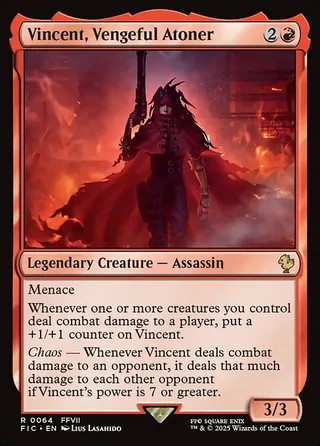
Reach seven power, then let one hit hurt the other opponents.
Vincent gains a counter when your creatures connect with a player. At power seven or more, his own combat damage to an opponent also deals that much damage to each other opponent. Menace helps him get through, but the power threshold and the successful hit both need support.
The damage sent to the other opponents is noncombat damage. It doesn't count as Vincent's commander combat damage against them. Dependable power boosts and evasion make the milestone more useful than hoping ordinary attacks will get him there safely. He's a combat-to-burn specialist with a clear target to build toward.
1,677 EDHREC decks (past two years; October 4, 2026). Oracle text and rulings. Compare singles printings and prices.
Shop Vincent, Vengeful Atoner2. Clive, Ifrit's Dominant
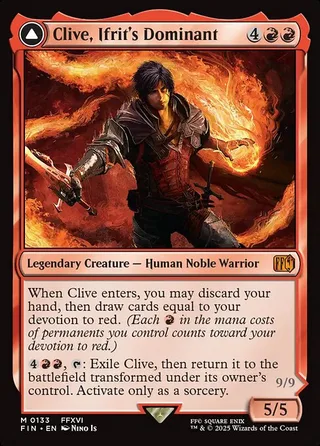
A red board can turn his entry into a better hand.
Clive can discard your hand when he enters and draw cards according to your red devotion. Devotion counts red mana symbols on permanents, not red cards in hand. His later transformation produces Ifrit, a Saga with a fight and red mana before it returns to the front face.
Look at the board before making the hand exchange. Discarding useful cards for a small draw can leave you worse off. The six-mana tap ability to transform is another substantial commitment. Clive suits devotion and transformation; a low-permanent spell deck may get more immediate help from a simpler spell engine.
7,480 EDHREC decks (past two years; October 4, 2026). Oracle text and rulings. Compare singles printings and prices.
Shop Clive, Ifrit's Dominant3. Chandra, Fire of Kaladesh
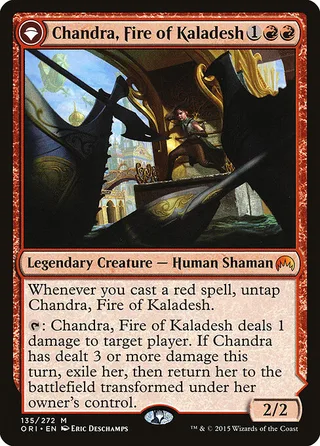
The creature Chandra can become your planeswalker.
Chandra begins as a legal legendary creature commander. Casting a red spell untaps her, and her tap ability transforms her after checking that she's dealt at least three damage that turn. The planeswalker face offers more damage and eventually an emblem, giving those early taps a purpose.
Red casts and taps need careful sequencing, plus enough cards and mana to continue. Spell copies alone won't supply the red spell casts that untap her. Once transformed, she needs protection from attackers. This Chandra is a transformation project; her eligibility doesn't give every Chandra planeswalker permission to be your commander.
3,605 EDHREC decks (past two years; October 4, 2026). Oracle text and rulings. Compare singles printings and prices.
Shop Chandra, Fire of Kaladesh4. Loki, God of Lies
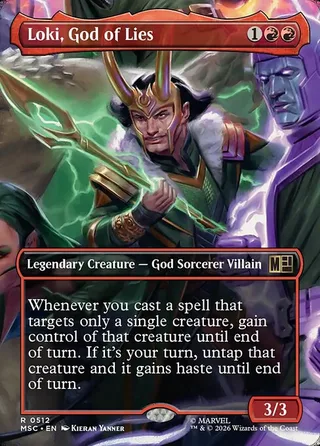
A single-creature spell can borrow that creature for the turn.
Loki temporarily takes a creature when you cast a spell targeting only it. On your turn, he also untaps it and gives it haste. Cheap targeting spells can become theft spells, and a separate sacrifice outlet can keep a borrowed creature from going back at the end of the turn.
The original spell still matters. If it deals lethal damage, you may not have a useful creature left to attack with. The untap and haste apply only on your turn, too. Loki rewards a particular targeting plan; an arbitrary spell with several targets won't let you take every creature it touches.
868 EDHREC decks (past two years; October 4, 2026). Oracle text and rulings. Compare singles printings and prices.
Shop Loki, God of Lies5. Combustion Man
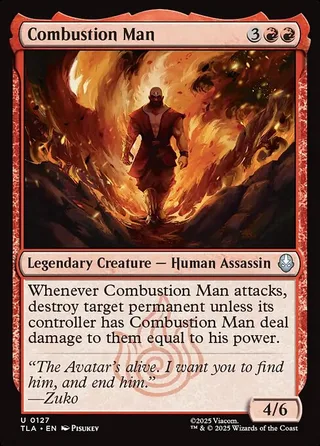
More power makes the opponent's choice harder.
When Combustion Man attacks, he targets a permanent. Its controller chooses whether it is destroyed or they take damage equal to his power. Growing the commander can make preserving that permanent painful, but the opponent still gets to choose. You can't treat the ability as unconditional removal.
An opponent may accept the damage to keep a card they need to win. Backup removal therefore matters alongside power boosts and safe attacks. Protection helps Combustion Man keep offering the choice, while other useful threats let the deck continue when he can't enter combat.
864 EDHREC decks (past two years; October 4, 2026). Oracle text and rulings. Compare singles printings and prices.
Shop Combustion Man6. Lovisa Coldeyes
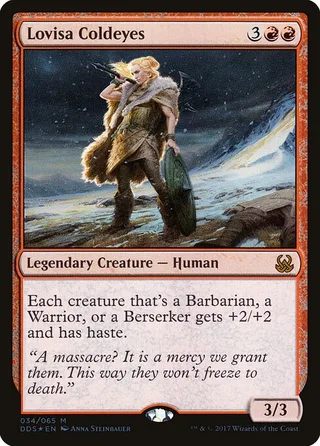
Three creature types get bigger and faster, on both sides.
Lovisa gives Barbarians, Warriors and Berserkers extra power, toughness and haste. A well-chosen tribal curve can attack immediately with stronger creatures. The effect also helps opposing creatures with those types, so look at the whole board rather than count only your own gains.
Check actual creature types; artwork or a character's name won't tell you whether the bonus applies. Draw and recovery keep the tribal attacks coming. Lovisa is a theme-first choice with a global benefit. If dependable resources matter more than playing those particular types, a commander that produces cards or bodies may suit you better.
847 EDHREC decks (past two years; October 4, 2026). Oracle text and rulings. Compare singles printings and prices.
Shop Lovisa Coldeyes7. Gandalf, Goblins' Bane
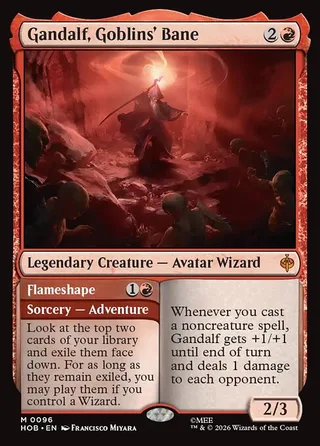
Noncreature spells grow the attacker and ping the table.
Gandalf gets larger for the turn and damages each opponent when you cast a noncreature spell. His Adventure exiles two cards you can play while you control a Wizard. That gives a spell-and-combat deck another way to find plays, but the Adventure and creature are separate uses of the card.
You need an actual Wizard on the battlefield for that permission and mana to use the cards. The power boost is temporary, so attack during the turn you're casting those spells. Gandalf fits combat and spell damage together; the Adventure doesn't simply put a permanent supply of extra cards into your hand.
704 EDHREC decks (past two years; October 4, 2026). Oracle text and rulings. Compare singles printings and prices.
Shop Gandalf, Goblins' Bane8. Spider-Punk
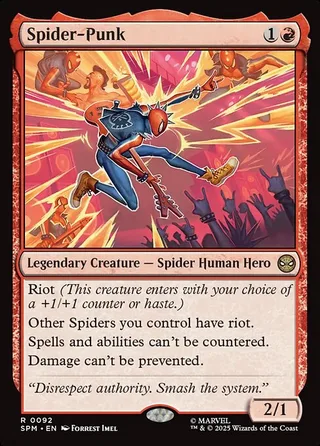
His protection from counters and prevention helps opponents too.
Spider-Punk and other Spiders can use riot. His broader abilities also stop spells and abilities from being countered and stop damage from being prevented. That can help your aggressive plan work, but the same rules apply to opposing spells and damage. You're changing what everyone can stop.
Explain those global effects to the other players before the game. Mono-red has fewer Spider choices than the full multicolor tribe, and the deck still needs to handle exile, bounce and other removal. Spider-Punk is a distinctive combat-support choice, with consequences to build around rather than a one-sided shield.
680 EDHREC decks (past two years; October 4, 2026). Oracle text and rulings. Compare singles printings and prices.
Shop Spider-Punk9. Subira, Tulzidi Caravanner
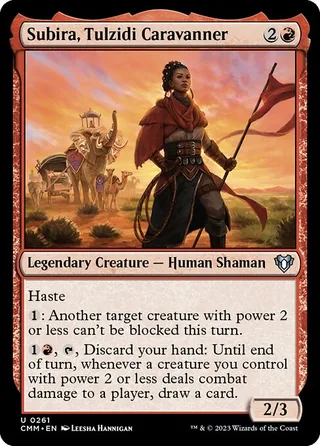
Small attackers can replace a hand you're ready to discard.
Subira can make another creature with power two or less unblockable for the turn. Her other ability discards your hand and lets qualifying small creatures draw cards when they deal combat damage to players that turn. A prepared wide board can turn a nearly empty hand into several new cards.
Use the abilities before damage. The unblockable ability checks power on resolution; pumping afterward does not remove that permission. The draw ability checks power just after damage, so a creature above power two then gives no card. If the attack is stopped, you may be left without a hand. Enough creatures, protection and a fallback draw engine make that risk more manageable.
595 EDHREC decks (past two years; October 4, 2026). Oracle text and rulings. Compare singles printings and prices.
Shop Subira, Tulzidi Caravanner10. Adamaro, First to Desire
A cheap threat whose size depends on opposing hands.
Adamaro's power and toughness follow the largest hand among your opponents. A draw-heavy table can make him a substantial body for the cost. You don't fully control that size, though, and he doesn't supply evasion, cards or mana to help the rest of your deck.
He's a niche choice for exploiting a particular table, rather than a general mono-red leader. Protection, evasion and independent card access have to come from elsewhere. Opponents emptying their hands can shrink him unexpectedly. Laelia offers a more predictable resource engine if that uncertainty isn't what you want from your commander.
644 EDHREC decks (past two years; October 4, 2026). Oracle text and rulings. Compare singles printings and prices.
Shop Adamaro, First to DesireImportant alternatives
Mono-Red Partner Commanders and Other Close Calls
Popularity helped us choose the 110 full profiles: we started with the highest-deck-count eligible individual entries in the sampled EDHREC feed, then ordered them within themes. That does not prove they are the strongest 110 cards. In particular, a commander commonly played with a partner or Background can look unpopular on its solo page. These eight researched alternatives help show what that cutoff misses.
- Krark, the Thumbless: cast an instant or sorcery and flip a coin. Losing returns the spell; winning copies it. Pairing Krark with Rograkh gives you a red-only alternative to Birgi for spell chains, but a copy or a returned spell does not guarantee you can keep casting for free.
- Rograkh, Son of Rohgahh: you get a zero-mana partner with first strike, menace and trample. That cheap body needs help to provide cards or mana. Kediss, Jeska and Krark offer different mono-red pairings; the popular multicolor combinations belong outside this guide.
- Dargo, the Shipwrecker: sacrificing artifacts and creatures for its additional cost, along with other such sacrifices that turn, reduces the generic mana you pay. Jeska offers a red-only partner and a different finish. You still need the sacrifices, the red mana and a way to cover commander tax.
- Gut, True Soul Zealot: an attack lets you trade another creature or an artifact for one tapped-and-attacking 4/1 Skeleton with menace. A red Background such as Guild Artisan adds another ability from the command zone. The Skeleton is black, but that token color does not add black to Gut’s color identity.
- Karlach, Fury of Avernus: attack during the first combat to untap the attackers, give them first strike and add another combat. Karlach offers red Background choices and a simpler way to get an extra attack than Moraug’s landfall timing. The first-combat condition stops each later attack from adding yet another phase.
- Ganax, Astral Hunter: Ganax and your other Dragons entering make Treasure, including token Dragons that would not trigger Lathliss. Choose Ganax for mana, Lathliss for extra bodies or Sarkhan for an earlier start. Any Background you choose must keep the combined identity within the guide’s mono-red scope.
- Neheb, Dreadhorde Champion: connect with a player or planeswalker to discard and replace cards while adding that much red mana for the rest of the turn. This Neheb gives you filtering and mana from a successful hit; the Eternal instead counts opposing life lost. A blocked attack may give the Champion no resource trigger.
- Drakuseth, Maw of Flames: attack to deal four damage to one target and three to each of up to two others. The targets must be different. Consider Drakuseth when you want a Dragon’s attack to deal immediate damage rather than grow Lathliss’s army, but budget for seven mana and a way to get that attack.
October 4 profile comparison: Dargo’s solo page showed 16 decks, while Dargo with Jeska showed 873; Ganax’s solo page showed 110, while Ganax with Dragon Cultist showed 368. Those pages describe separate samples. Adding them would not give a reliable total, and the larger paired count does not show that those decks win more. The mono-red census and each linked profile provide the dated adoption context. These eight alternatives sit outside the 110 full-profile count. We checked their abilities against current Oracle records too.
Rules and choices
Mono-Red Commander FAQ
Who is the best mono-red commander overall?
It depends on what you want to play. Start with Krenko, Mob Boss for Goblins, Solphim for burn or Lathliss for Dragon tribal. Among the six commander profiles checked in the tournament section, Magda has the strongest recorded evidence here. We have not compared every mono-red competitive option. One overall winner would hide the different jobs these commanders do.
Can I include a partner or Background?
Only when the card’s relevant ability permits a second commander. The combined color identity must remain red only for this guide’s scope. We count one gameplay card once, not every possible pairing or reprint.
Can a colorless-looking artifact have red identity?
Yes. Bosh has a colorless mana cost but red in its activated ability, so its identity is red. Identity also includes relevant symbols on both faces. Primal Conqueror is red-green; the mono-red Etali here is Primal Storm.
Can a planeswalker or Vehicle be my commander?
Daretti, Scrap Savant has explicit permission. Chandra, Fire of Kaladesh starts as a legendary creature. Current rules also admit legendary Vehicles and Spacecraft with printed power and toughness, so RMS Titanic qualifies. An ordinary legendary planeswalker does not automatically qualify.
Does burn from my commander count toward twenty-one damage?
No. The twenty-one rule counts combat damage from the same commander. Its noncombat damage is ordinary damage. When a commander changes controller, its combat damage still belongs to that same commander.
Do spell copies trigger every storm commander?
No. Ashling explicitly rewards casts and copies. Birgi and Urabrask require casts. Copying a spell already on the stack normally is not casting it; an effect instructing you to cast a copy is a different case.
Do several damage multipliers always stack in the order I choose?
No. Applicable replacement effects follow the rules for the affected player or permanent’s controller choosing the order. Ojer Axonil’s floor and Solphim’s doubling should not be combined using only the most favorable arithmetic.
Evidence and editorial judgment
Mono-Red Commander Ranking Method
- Scope: 110 distinct paper-legal cards with exactly red color identity, released by October 4, 2026. We checked a 300-row EDHREC census against current Oracle records and found 262 unique eligible candidates; paired profiles, duplicates and ineligible identities were excluded.
- Selection: we sampled 300 mono-red census rows, checked 270 individual Oracle records, and found 262 eligible unique cards. The 110 full profiles start with the highest-deck-count eligible individual entries in that sample. Theme order and leading recommendations are editorial judgments about resources, cost, support, a finish and resilience. The sample is not the complete legal card pool, and the popularity cutoff is not a strength test. Eight researched close calls separately challenge its omissions.
- Close calls: Mob Boss supplies a larger activation-driven army than Tin Street Kingpin but needs haste or time. Solphim covers broader opposing noncombat damage, while Axonil better rewards small red pings and power investment. Lathliss supplies extra permanent Dragons; Zirilan instead supplies exact temporary targets. These are practical editorial comparisons, not measured head-to-head win rates.
- Coverage: you will find established deck plans and more unusual projects. We researched 100-plus candidates, but not every legal red commander appears here, and a specialist near the end of a theme is not necessarily as strong as its leading recommendation.
- Popularity: profile totals are EDHREC’s past-two-years collected public decklists, checked October 4. They are not player counts, sales, wins or a census of every deck.
- Tournaments: the compared view uses the past six months and events of at least fifty players. We retain pagination and event labels. Specific recorded finishes support Magda and Godo; incomplete, mixed-bracket or unavailable views do not become claimed win rates.
- Rules: each full profile links current Oracle text and the pictured printing. Supporting named interactions use separate checked card records. The complete card, including relevant second-face information, determines eligibility.
- Bracket labels: these are suggested build directions. The actual list, Game Changers, speed, combos and resource denial determine the appropriate bracket.
- Experience: our recommendations come from card rules, public decks and recorded results. They are not based on first-hand playtesting, personal tournament finishes or controlled matchup data.
- Shopping: each button opens the pictured product and finish. Compare condition, shipping and stock before buying. The links are disclosed affiliate links; they do not decide our picks or promise the lowest price.
EDHREC’s methodology explains its public-deck collection and limits. New rules, bans, products and tournament results can change these choices. The evidence date tells you when we last checked them.
Source links
Mono-Red Commander Guide Sources
- Wizards: current Commander rules and brackets and banned and restricted lists.
- Wizards: October 2025 bracket update and February 2026 update.
- Wizards: legendary Vehicle and Spacecraft eligibility. Printed power and toughness matter.
- EDHREC: mono-red adoption and methodology FAQ. Individual commander pages are linked beside every profile.
- EDHTop16: recorded tournament database. The cEDH section links filtered profiles and specific named events.
- Scryfall: Oracle card records. Every profile links its exact printing and rules.