


Before you play
Star Trek Rules Quick Check
- The most costly mistakes here are missing a payment or counting the wrong thing. Check the short answer, then use the named section for the full example.
| Play mistake | Correct rule |
|---|---|
| Attacking with a ship you just cast | Station charges it, but it still needs haste to attack that turn. |
| Treating Beam Me Up as a free second cast | Pay its listed cost and return one of your creatures; sorceries keep sorcery timing. |
| Removing every ability when you Assimilate | It loses its other creature types, not automatically its abilities. |
| Counting a changeling for Federation | A changeling is Borg too, so Federation excludes its creature types. |
| Counting five lands as five worlds | Count different names; extra copies of one land add no new name. |
| Counting each mode as another dilemma | Choosing several modes for one spell is one dilemma. |
| Triggering Seek Out on draw three | It’s your second draw of that turn, including an opponent’s turn. |
| Counting myriad tokens for Battlefront | Count opponents you declared attackers against, not tokens entering attacking. |
Charge the ship
Spacecraft and Station Rules
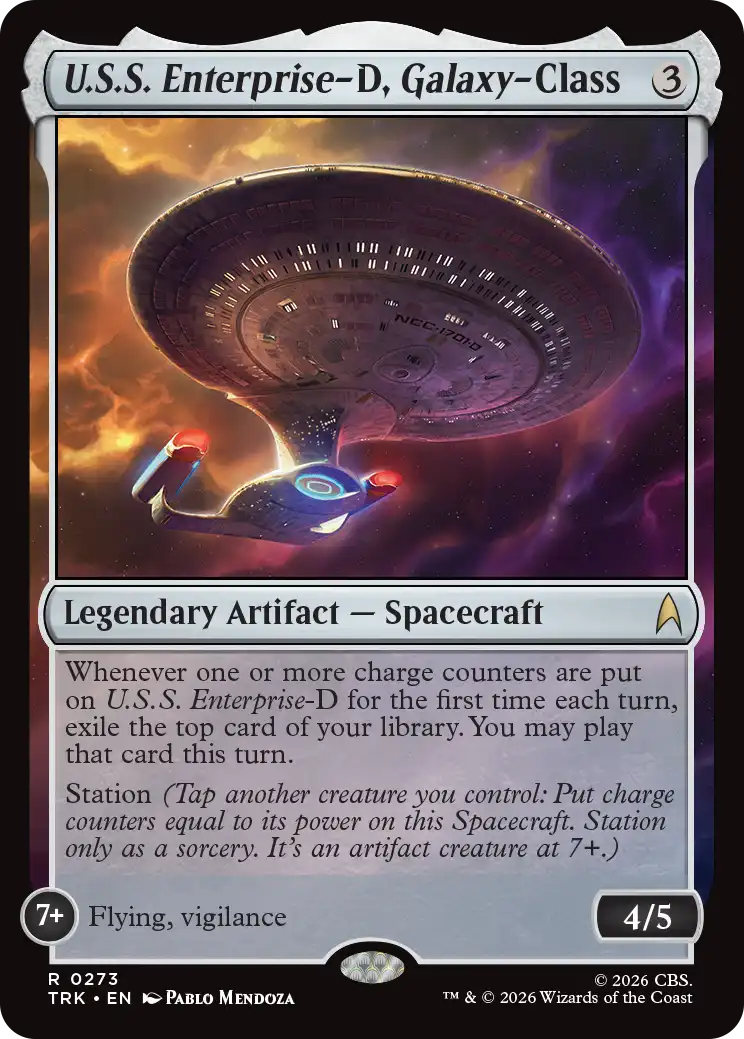
- A Spacecraft is an artifact subtype. It doesn’t automatically enter as a creature. Read its active text and charge-counter thresholds.
- To activate Station, tap another untapped creature you control. You can do this only during your main phase while the stack is empty.
- A creature that entered this turn can help with Station. The ability belongs to the Spacecraft and instructs you to tap another creature; it isn’t that creature’s own tap-symbol ability.
- Station uses the creature’s power as the ability resolves, not when you tap it. If that creature has left the battlefield, use its last known power. Opponents can respond after you pay the cost.
- U.S.S. Enterprise-D, Galaxy-Class becomes a 4/5 artifact creature with flying and vigilance at seven or more charge counters. Those counters stay; you don’t spend seven to turn it on.
- Station taps the helping creature, not the ship. It doesn’t untap either of them.
- Reaching seven counters doesn’t give Enterprise haste. If you cast it this turn, it normally can’t attack yet; controlling it since your turn began is enough, even if it only just became a creature.
- If Enterprise drops below seven counters, its seven-counter effect no longer makes it a creature or grants flying and vigilance.
- Its top ability triggers the first time one or more charge counters are put on it each turn. Multiple Station activations that turn don’t each give another exiled card.
- The exiled card may be played that turn, which includes a land if you have a land play available. You still pay for a spell, and normal timing applies.
- A Spacecraft threshold without printed power and toughness doesn’t make it a creature. Reaching a number only grants the effects that card actually lists. The official Spacecraft and Station rules explain the thresholds.
Reuse a spell
Star Trek Beam Me Up Rules
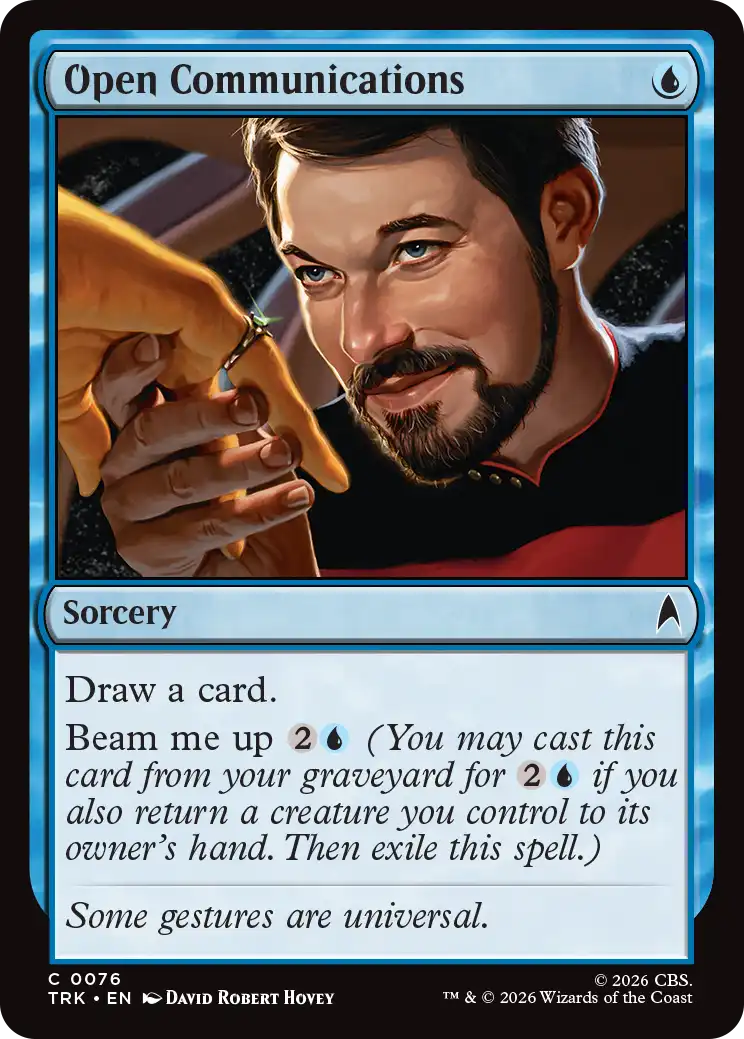
- Beam Me Up gives certain instants and sorceries another cast from your graveyard. Pay the listed Beam Me Up cost and return a creature you control to its owner’s hand.
- Open Communications normally costs one blue mana and draws a card. Its graveyard cast costs two generic mana plus one blue, as well as returning your creature. Its mana value stays 1.
- Returning the creature is a cost, so an opponent can’t wait for you to cast the spell and then remove that creature to prevent the return. They can still respond to the spell itself.
- You still follow the spell’s timing. Open Communications is a sorcery, so you normally need your own main phase and an empty stack. It isn’t an instant-speed rescue.
- After a Beam Me Up cast, the spell is exiled whether it resolves, gets countered or loses all legal targets. You don’t keep casting it from your graveyard.
- If your creature has an enters ability, returning and replaying it can give you another use. Budget for both spells instead of treating the return as a free extra creature.
- If you control a creature owned by an opponent, returning it sends it to that opponent’s hand. Control doesn’t change ownership. Wizards explains Beam Me Up’s costs and timing here.
Join the Collective
Assimilate and Borg Creature Types
- Assimilate brings the specified creature or card under your control and adds a +1/+1 counter. It becomes a Borg artifact creature and loses its other creature types.
- When the instruction identifies a card outside the battlefield, that card enters the battlefield under your control. When it identifies a creature already on the battlefield, you gain control of that existing permanent.
- Assimilating a creature already on the battlefield doesn’t make it enter again. Don’t expect an enters trigger just because control changed.
- It keeps other card types, non-creature subtypes and supertypes. A legendary creature remains legendary; Assimilate doesn’t remove the legend rule.
- Assimilate doesn’t untap the creature or give it haste. A newly controlled creature normally can’t attack or use its own tap-symbol abilities that turn. It can still help another Spacecraft with Station.
- It also doesn’t say the creature loses its abilities. Losing Human or Officer is different from losing its printed rules text.
- For Federation, a newly assimilated Borg no longer contributes its other creature types. That gives Borg and Federation different deckbuilding incentives. Wizards’ Assimilate explanation covers both zones.
- The Borg Queen’s full precon remains a separate question. The official decklist article still has unrevealed-content placeholders in this October 21 snapshot; the Borg deck preview is scheduled for October 26.
Count the types
Federation and Non-Borg Creature Types
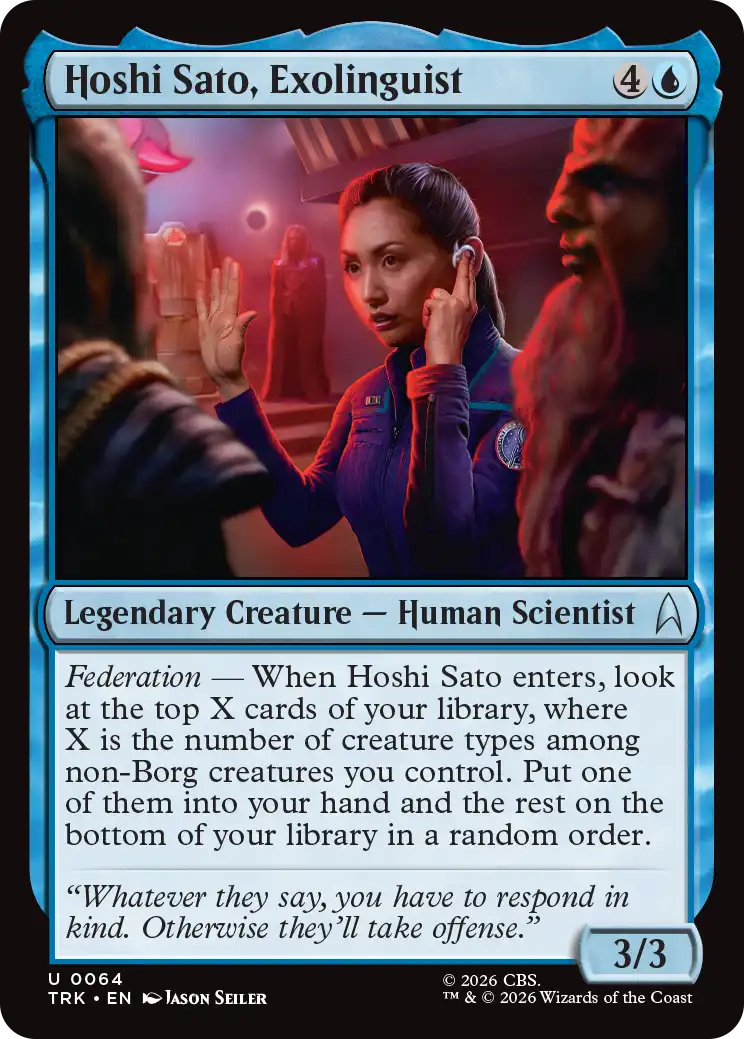
- Federation abilities count creature types among the non-Borg creatures you control. They don’t simply count creatures or colors.
- Wizards’ Hoshi Sato and Captain Benjamin Sisko example gives three types: Human, Scientist and Officer. A type appearing twice still counts once.
- A Borg creature contributes none of its creature types to Federation, even if it also has a useful type such as Officer. Another non-Borg Officer can still supply Officer.
- Changeling makes a creature every creature type, including Borg. It therefore contributes no types to Federation unless another effect changes its types.
- Read the individual Federation ability to see what it does with that total. The word identifies a theme; it doesn’t give every Federation card the same effect. See Wizards’ Federation example.
Count the names
Strange New Worlds and Land Names
- Strange New Worlds counts different land names among lands you control. It doesn’t count basic land types or total lands.
- Three Forests, one Island and one Breeding Pool give three different names. Playing a fourth Forest adds mana potential but doesn’t increase that count.
- Different cards use the count in different ways. The Traveler uses it for power; Deep Space Scan checks it when the spell resolves.
- If an opponent removes one of your uniquely named lands before Deep Space Scan resolves, the number can change. Count the battlefield at the time the particular ability asks you to. Wizards’ Strange New Worlds explanation gives the named-land example.
Count the choice
Facing a Dilemma in Star Trek
- You face a dilemma when you choose one or more modes for a modal spell or ability. Look for a list of options introduced by an instruction such as “Choose one.”
- The choice counts even if the spell is later countered or fails to resolve. You already faced the dilemma when you chose its modes.
- Choosing two modes for one spell is one dilemma, not two. Choosing the same mode repeatedly, where allowed, still counts as one.
- If a triggered ability gives you no legal mode to choose, you haven’t faced a dilemma. A trigger appearing on the stack isn’t enough by itself.
- For Captain Benjamin Sisko’s count, include earlier modal spells and abilities from that turn even when they didn’t resolve. Don’t count every ordinary decision, such as which creature to attack with. The official dilemma explanation defines the qualifying choice.
Draw card two
Seek Out and Jean-Luc Picard
- Seek Out highlights abilities that trigger when you draw your second card each turn. That can happen on your turn or an opponent’s turn.
- The permanent doesn’t need to be present for your first draw. If your first draw is Picard, then you cast him and draw a second card, his Seek Out ability can trigger.
- Your third draw is not another second draw. To get another Seek Out trigger without other effects, arrange two draws on another player’s turn.
- Jean-Luc Picard, Luminary can put a +1/+1 counter on up to one other target creature and two charge counters on up to one target Spacecraft. Picard can’t be his own “other” creature target.
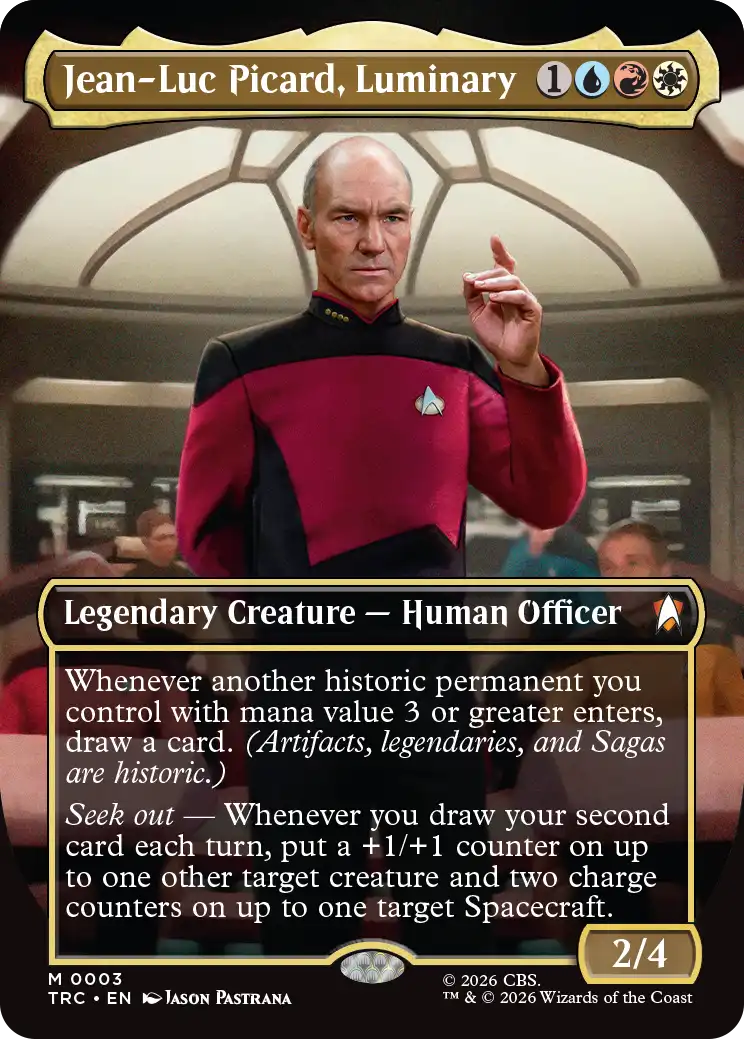
- Picard also draws a card when another historic permanent you control with mana value 3 or greater enters. Artifacts, legendary permanents and Sagas are historic; a cheap artifact doesn’t qualify solely because it is historic.
- An Enterprise-D entering under your control qualifies for Picard’s draw ability. Whether that draw is your second of the turn depends on what you already drew. The official Seek Out example explains the turn-by-turn count.
Declare the attack
Battlefront in Star Trek Commander
- Battlefront tracks how many different opponents you declared creatures as attacking this turn. It doesn’t count damage, creatures or combat phases.
- Myriad tokens enter attacking other opponents, but those tokens weren’t declared as attackers. Attacking one opponent with the original myriad creature still gives one opponent for Battlefront.
- Extra combats keep the same turn’s count. Attack opponent A first, then B and C in another combat, and the total becomes three different opponents.
- Attack A again and only one new opponent in the second combat, and the total is two. Attacking A twice doesn’t count A twice.
- Different Battlefront cards use the total differently. Worf’s example exiles cards when his ability triggers; follow that card’s conditions rather than assuming every Battlefront card draws cards or grants an attack bonus. Wizards demonstrates both extra-combat cases.
Before your first game
Star Trek Release Dates and Sources
- Prereleases begin November 6, 2026, and tabletop release is November 13. For product contents and the regional delivery delays, use the Star Trek release and product guide.
- This guide explains confirmed preview mechanics checked October 21, 2026. It doesn’t rank unrevealed cards or claim a tested Borg upgrade list.
- Primary rules source: Matt Tabak’s October 20 Star Trek mechanics article. The pictured card faces provide the exact costs, types and conditions used in their examples. The Comprehensive Rules cover changeling, creature attack restrictions, Station and last known information (rules 702.73a, 302.6, 702.184 and 608.2h).
- If you’re choosing a Commander style before buying a deck, compare the Commander themes and play expectations. For a complete existing creature-type list, the Ur-Sphinx deck guide shows how a full 100-card plan differs from a mechanics preview.
For a separate paid digital Sealed event, the Reality Fracture Arena Direct guide distinguishes its gem entry and physical prize claims. To watch Standard before choosing a deck, use the Arena Championship 13 viewing guide.