


Before you open
Star Trek Prerelease Dates and Pack Contents

- Prerelease events begin November 6, 2026; the set’s general release is November 13. Confirm the session date with your store.
- The kit contains six Play Boosters, one traditional foil promo card, a deck box and a Spindown die. Use the opened cards and promo for your Sealed pool, plus basic lands.
- Ask about the entry fee, round count, basic-land supply and prizes before paying. Publisher-wide dates don’t establish those local terms.
- You’re building a Sealed deck, not a 100-card Commander deck. The four-deck Commander comparison answers a different purchase and play question.
Find your colors
How to Choose Two Colors in Star Trek Sealed
- Sort the pool into five colors, multicolor cards, artifacts and lands. Make a second small pile for cards that answer opposing threats.
- For each plausible two-color pair, lay out the spells you can cast on turns two and three. If one pair offers a strong rare but almost no early plays, compare it with the pair that can develop a board reliably.
- Then check your finishers and removal. Favor the pair with a workable game plan across a full match, rather than the pair with the highest single-card ceiling.
- Add a third color only when the card’s impact and your actual fixing justify the slower starts. A land that produces the wrong color isn’t free just because another card rewards different land names.
- Use the full official card gallery to check an unfamiliar printing. Your pool determines your options; you can’t add a card you saw online but didn’t open.
Make the first turns work
A 40-Card Star Trek Sealed Starting Plan
| Slot | Starting point | What to check |
|---|---|---|
| Lands | 17 | Count colored sources for the spells you want to cast early. |
| Other cards | 23 | Choose creatures, interaction and finishers that work together. |
| Deck size | 40 total | Forty is a consistency recommendation; Sealed’s minimum is 40, not an exact-size rule. |
- Seventeen lands is a baseline, not a requirement. An unusually expensive pool or demanding colored costs can need more; don’t cut a land just to squeeze in another exciting spell.
- Prefer enough two- and three-mana plays to affect the board early. Trim a redundant expensive threat before cutting the cards that let you reach your late game.
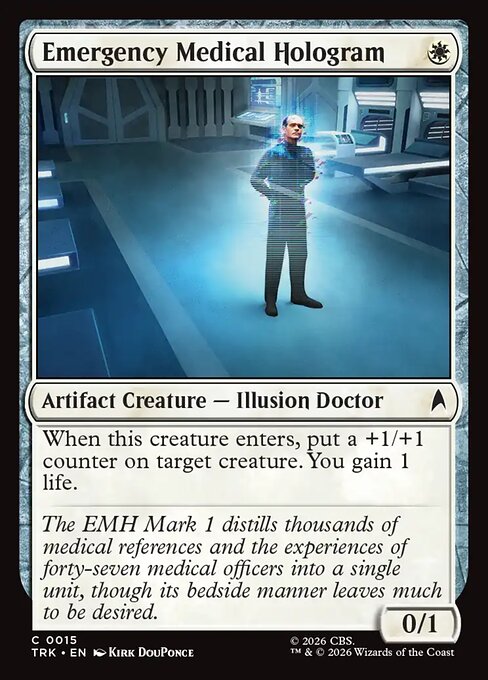
- White’s one-mana Emergency Medical Hologram is a 0/1 before its enters counter. Its enters ability puts a +1/+1 counter on a target creature and gains you 1 life if that target remains legal. You can target the Hologram itself or another creature.
- If the Hologram’s target becomes illegal before its enters ability resolves, you get neither the counter nor the life. For example, removing the other creature you targeted stops both effects.
- After the first game, change cards that failed to solve the opponent’s actual threats. Keep the unused pool available as your sideboard, and follow your organizer’s rules for deck changes.
Read the signals
Star Trek’s Ten Limited Color Pairs
| Colors | Publisher’s theme | Your pool question |
|---|---|---|
| White-blue | Spacecraft and Artificers | Crew your ships without leaving every blocker tapped. |
| Blue-black | Dilemma control | Choose the mode that answers the current board. |
| Black-red | Klingons and creatures dying | Keep useful fodder separate from creatures you need to defend. |
| Red-green | Away Team landfall | Check how many extra land plays and landfall payoffs you actually opened. |
| Green-white | Doctors and counters | Count both counter enablers and creatures that reward them. |
| White-black | Borg artifact creatures | Check the number of artifact creatures before relying on tribal payoffs. |
| Blue-red | Scientists and noncreatures | Balance spell triggers with creatures that can survive combat. |
| Black-green | Archaeology and the graveyard | Include ways to stock the graveyard and ways to use it. |
| Red-white | Command and 8+ total power | Add your creatures’ actual power, including modifiers. |
| Green-blue | Strange new worlds | Different land names help, but reliable colored mana still comes first. |
- These are Wizards’ announced themes, not a win-rate ranking. Sealed may give you a good two-color deck without both of its multicolor signposts.
- Constable Odo costs three generic mana and two white-or-blue hybrid mana. A mono-white or mono-blue mana base can pay those symbols; you don’t need both colors just to cast Odo.
- Odo’s enters ability either taps an opposing creature and adds two stun counters, or investigates twice. Choose temporary board control when it changes the race; choose Clues when you have time and mana to use them.
Keep flexible cards
Star Trek Removal and Artifact Answers
- Artifacts matter here because Spacecraft and Borg share the battlefield with ordinary creatures. An answer that can hit an artifact has more possible work than it would in a pool with very few artifact threats.
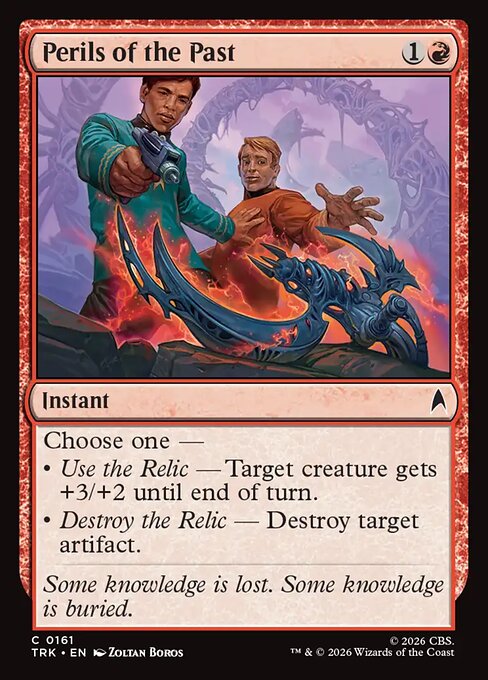
- Perils of the Past costs one generic and one red mana. Its modes give a target creature +3/+2 for the turn, or destroy a target artifact. It does not destroy an ordinary nonartifact creature.
- That flexibility lets you keep an artifact answer in your main deck without always drawing a dead spell against a creature-heavy opponent. You still need a legal target for the mode you choose.
- Separate removal from temporary interference. Odo can delay a creature, but tapping and stun counters don’t remove its abilities or permanently destroy it.
- Don’t force weak answers into the deck just to hit a removal quota. Ask which opposing problem each card actually solves, then keep a balance of threats and interaction.
Plan the next turn
Spacecraft Decisions in Star Trek Sealed
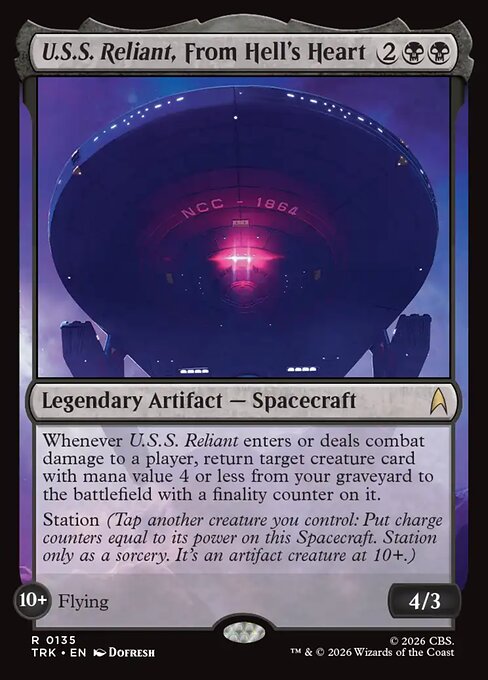
- U.S.S. Reliant, From Hell’s Heart costs two generic and two black mana. Its enters trigger can return a creature card with mana value 4 or less from your graveyard with a finality counter. You don’t need ten charge counters for that trigger.
- Reliant also returns a qualifying creature when it deals combat damage to a player. If a returned creature with a finality counter would die, exile it instead of putting it in the graveyard.
- Station only as a sorcery, by tapping another untapped creature you control. Count its power when Station resolves, not when it taps. Four counters plus six more reaches ten; a 4-power crew member alone does not.
- A creature that taps at 4 power but has 7 power when Station resolves adds seven counters. If it leaves the battlefield first, use its last power there. Negative power adds no counters and does not subtract existing counters.
- A crew member tapped for Station won’t be available as a normal untapped blocker. Decide which attacker you can afford to let through before charging a ship.
- A newly entered creature can help pay Station’s tap-another-creature cost. Reaching ten counters still doesn’t let a newly entered Spacecraft attack without haste.
- A ship you’ve controlled continuously since your turn began can attack once it becomes a creature, even if it only just reached its Station threshold. Becoming a creature does not restart that clock.
- For the full timing examples, read the Star Trek rules mistakes guide. Use your ship’s exact printed thresholds rather than assuming every Spacecraft turns on at ten.
Before round one
Star Trek Prerelease Preparation Checklist
- Lay out a sample opening hand and name what each land casts. A hand with three lands can still miss the colors your early spells need.
- Choose a backup color pair before the first round if two builds look close. Keep the spare cards sorted so a sideboard change doesn’t become a rushed rebuild.
- Bring sleeves, a way to track counters, and a clear way to track life. Ask a judge when a new mechanic creates a dispute.
- For regional product delivery notices, use the Star Trek release and product guide. A delay to a particular product doesn’t automatically move your store’s event.
- Sources checked October 30, 2026: official prerelease guide, release notes and printed cards. The pool-selection advice is editorial guidance, not a tested color ranking.