


Commander ranking
Best Hobbit Sorceries in Commander
- Inside Information is our first pick for casual multiplayer Commander. It can spend life rather than mana on multiple opposing spells, giving it a larger potential upgrade over an ordinary role-player. Desolation of Smaug is our first choice specifically for a Dragon deck.
- This is an editorial strongest-to-weakest recommendation order for those Commander decks, not a ranking of Standard results. We weigh the effect you gain over established alternatives, the resources and setup it needs, and how often its intended deck can make use of it. The profiles explain where a lower-ranked card is the better fit.
- We prioritize distinctive payoff with workable support over a familiar effect that a deck can already obtain more efficiently. Novelty alone does not make a card strong, and none of these rankings claims measured win rates.
- The ten profiles cover every unique front-face sorcery in the main HOB set. Black, red, white and green decks have different legal choices, so compare within the jobs and colors your deck actually needs. The separate Standard section retains the dated tournament evidence.
Life-rich decks borrowing an opponent’s cards
1. Inside Information
{X}{B}{B} · HOB 76
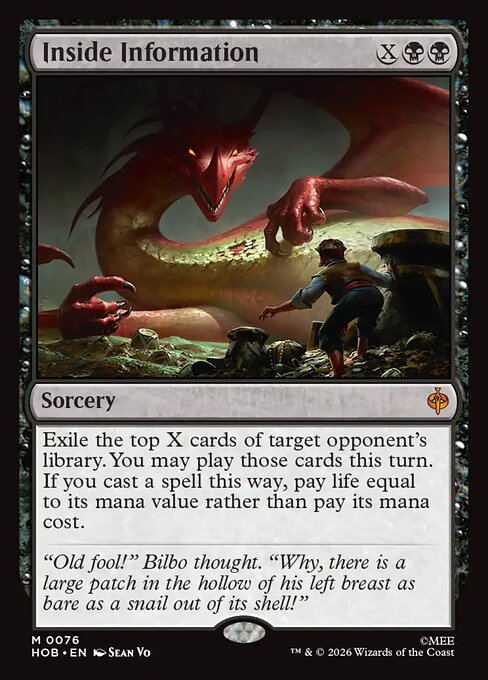
- This is the ambitious option for black decks with plenty of life to spend. Pay X plus two black mana to exile the top X cards of one opponent’s library, then use those cards during the current turn.
- Casting an exiled spell replaces its mana cost with life equal to its mana value. Additional costs still apply, and you cannot choose another alternative cost such as overload. X in a stolen spell’s mana cost must be zero. You also follow normal timing restrictions, and an exiled land still uses an available land play.
- For example, X equal to three exiles the top three cards face up. You might find a useful spell, a land you can no longer play, and an answer with no legal target. That uncertainty makes it a value gamble rather than a dependable tutor.
- The permission expires this turn. Cast it while you still have time, life and resources to use what you find; do not save it for an end step expecting to keep the cards for tomorrow.
- This is our first Commander pick because it can turn a healthy life total into several spells without paying their mana costs, in a deck whose only required color is black. At X equal to four, you spend six mana to see four cards; casting a six-mana spell and a four-mana spell among them would then cost 10 life, plus any additional costs. That is an example of its ceiling, not an expected result.
- Outrageous Robbery costs the same X plus two black and works at instant speed. Its stolen cards remain available while exiled, but you still pay mana to cast them. Choose Robbery for patience and flexibility; choose Inside Information when you can spend life to convert several cards into plays immediately.
- Villainous Wealth also casts opposing spells without their mana costs, but requires black, green and blue and only casts spells with mana value X or less. Inside Information has no corresponding mana-value ceiling, though life, legal targets and the current-turn limit can stop you.
- Why it is not an automatic staple: you see only one opponent’s top cards, cannot plan the hits, and may uncover expensive spells you cannot safely pay life for. It is a value spell for casual multiplayer Commander with room for variance, not a reliable combo search or a recommendation for competitive Commander.
Dragon decks clearing smaller creatures
2. Desolation of Smaug
{2}{R}{R} · HOB 93
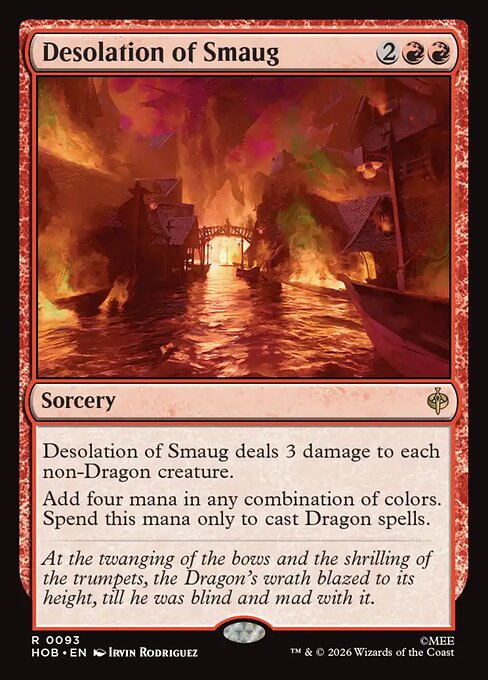
- A Dragon deck can clear small non-Dragon creatures and immediately use four mana toward another Dragon spell. Your Dragons avoid the damage, while utility creatures and smaller blockers may disappear.
- Your own non-Dragons also take 3 damage. Count the creatures you would lose before treating this as a one-sided wipe, and remember that larger non-Dragons can survive.
- The four mana can be any combination of colors, but it can only pay for Dragon spells. It cannot cast an ordinary ramp spell or pay an activated ability. Have a Dragon ready to cast in the same phase rather than counting this as an unrestricted refund.
- This is the better first pick specifically for Dragons. Clearing smaller blockers and then casting a Dragon can change the board in one turn, with no need to borrow an opponent’s cards. It ranks below Inside Information across our wider Commander audience because the mana restriction and Dragon requirement exclude many red decks.
- Crux of Fate costs five mana, including two black, and can destroy all non-Dragons regardless of toughness. Desolation costs four in red and supplies Dragon-only mana, but 3 damage leaves larger creatures alive. Take Crux when you need the more complete wipe; take Desolation when the smaller sweep plus a Dragon follow-up is the turn you want.
Small threats and indestructible creatures
3. Gnashing of Teeth
{1}{B}{B} · HOB 69
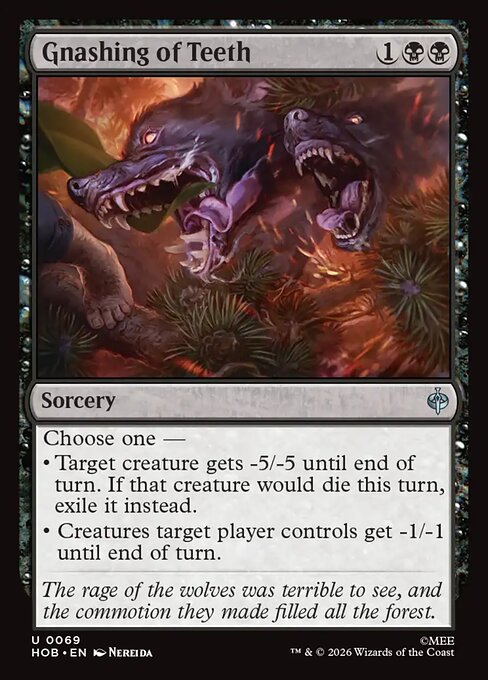
- Choose between giving one creature -5/-5 or giving all creatures controlled by one player -1/-1 for the turn. The first mode can remove an indestructible creature by reducing its toughness to zero; the second can clear a player’s small tokens.
- The exile replacement belongs to the -5/-5 mode. It does not make the other mode exile an entire token board, and the -1/-1 mode affects one player rather than every opponent.
- Three mana and two black symbols are a meaningful commitment. Prefer it when the two modes answer problems you actually face, such as an indestructible engine or several one-toughness creatures. A creature with enough toughness can survive -5/-5.
- Third place reflects useful choices on one card, rather than superior removal efficiency. Infernal Grasp costs two mana at instant speed and loses 2 life, making it easier to hold up against an ordinary threat. Gnashing earns consideration when toughness reduction or one player’s tiny tokens are the specific problem.
- Toxic Deluge also costs three mana, asks you to pay life, and gives every creature -X/-X. It scales to a whole table and larger creatures; Gnashing preserves the rest of the board but its small-creature mode is much narrower. Do not buy Gnashing expecting a replacement for a full sweeper.
Wide boards and counter synergies
4. Moment of Glory
{W} · HOB 21
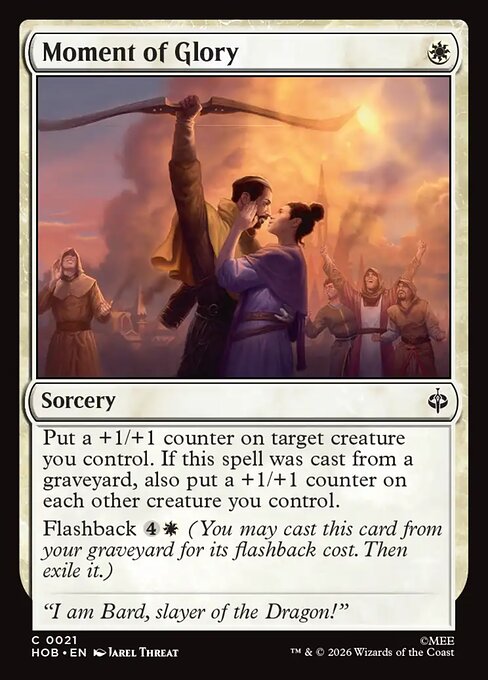
- One white mana puts a permanent +1/+1 counter on one creature you control. The bigger payoff comes from the graveyard: its five-mana flashback also puts a counter on each of your other creatures.
- Use the first cast to improve an early creature, then save the second for a wider board. Tokens and creatures that reward counters make the later cast more attractive than it would be in a deck with only one large attacker.
- It still targets a creature you control. If that sole target becomes illegal before resolution, the spell does not resolve and the other creatures receive no counters. With normal sorcery timing, it is not a surprise combat trick or a response to removal. Flashback exiles the spell afterward even if it is countered, so it does not give you endless repeat casts.
- Fourth is for counter decks and wide creature boards that can use both casts. Unbreakable Formation gives your creatures indestructible for three mana and, when cast in your main phase, adds a counter and vigilance to each. Formation is the stronger protection slot; Moment offers an early counter and a later graveyard use, but it does not grant indestructible or hexproof. Its counters can help against damage or toughness reduction, but they do not stop a destroy or exile effect.
Removal with expendable permanents
5. Stir Up Trouble
{B} · HOB 84
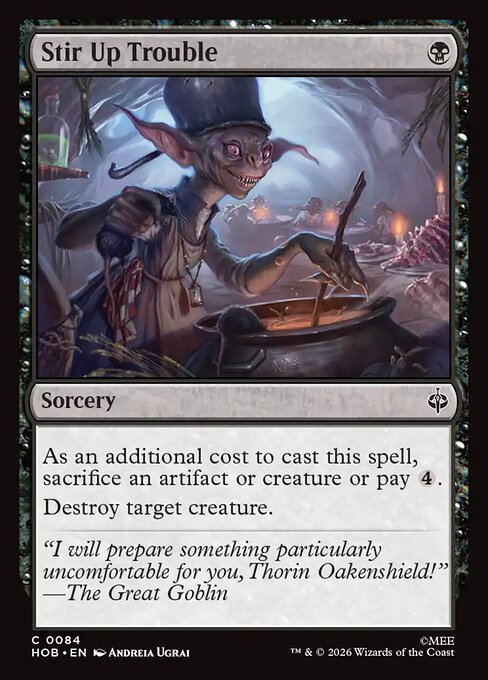
- Consider it if your black deck already makes creatures or artifacts it can afford to lose. One black mana destroys a creature, provided you also sacrifice an artifact or creature. You can pay four extra mana instead of sacrificing, making its normal total cost five.
- A spare Food or Treasure can pay the sacrifice cost, but you cannot sacrifice the same token both for this spell and for its own ability. Decide whether you need the removal more than that token’s other benefit.
- The sacrifice is paid when you cast the spell. If an opponent counters it or removes its target, you do not get your sacrificed permanent back. Normally, you cast this sorcery in your own main phase while the stack is empty, so keep instant-speed removal for surprises on another player’s turn.
- Choose it over Gnashing of Teeth when the one-mana sacrifice option fits your deck and you need to destroy one creature. Gnashing costs more, but its toughness reduction can answer indestructible creatures that Stir Up Trouble cannot destroy.
- Fifth place is a narrower recommendation than our original first placement. Bone Splinters already destroys a creature for one black mana plus a sacrificed creature. Stir’s meaningful extra flexibility is sacrificing an artifact instead, or paying four additional mana when you cannot sacrifice. That earns a look in a deck making expendable artifacts, rather than in every black deck.
- Eaten Alive can exile a creature or planeswalker for one black plus a creature sacrifice, or for five mana without it. If you mainly sacrifice creatures, exile and planeswalker coverage are strong reasons to prefer Eaten Alive. Stir’s artifact option is its distinct selling point.
- Feed the Swarm costs two mana and life but also answers an opponent’s enchantment. Together with instant-speed options such as Infernal Grasp, it shows why Stir does not deserve the first Commander slot simply for being cheap. The October 8 Standard registrations below answer a separate format question.
Late landfall payoffs
6. Through the Forest Gate
{6}{G}{G} · HOB 137
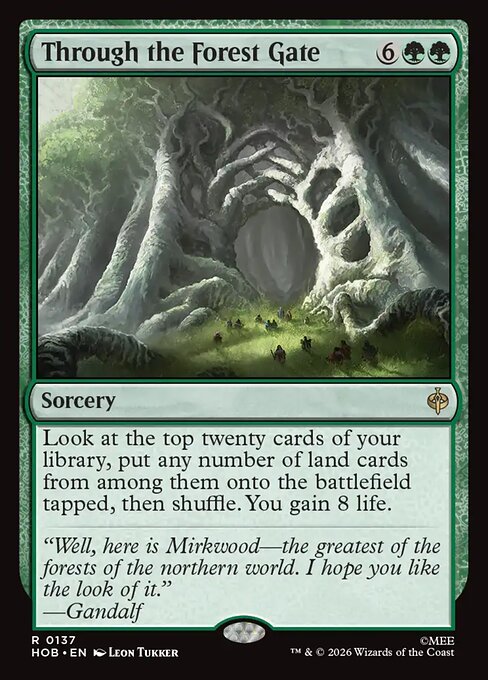
- At eight mana, this belongs near the expensive end of a dedicated land deck. Look at your top twenty cards, put any number of the lands among them onto the battlefield tapped, shuffle, and gain 8 life.
- Several lands entering together can trigger landfall repeatedly. The spell only puts lands onto the battlefield, so it will not also deploy the creatures and artifacts you see.
- The lands enter tapped and the number found is uncertain. Build enough early ramp to reach eight mana without this card, and choose it for a large late payoff rather than for fixing an opening hand.
- Sixth place is a landfall payoff, not an early ramp recommendation. In a hypothetical 80-card remaining library containing 32 lands, looking at twenty finds eight lands on average. The actual number depends on your remaining deck, and an average is not a guarantee.
- Splendid Reclamation costs four mana and returns the lands already in your graveyard tapped, so prefer it when you deliberately stock that zone. Forest Gate asks for no graveyard setup but costs eight. Genesis Wave at eight mana reveals only five cards, yet can put eligible nonland permanents into play too. Forest Gate sees much deeper specifically for lands.
An Army plus a replacement card
7. Rage into the Valley
{2}{B} · HOB 79
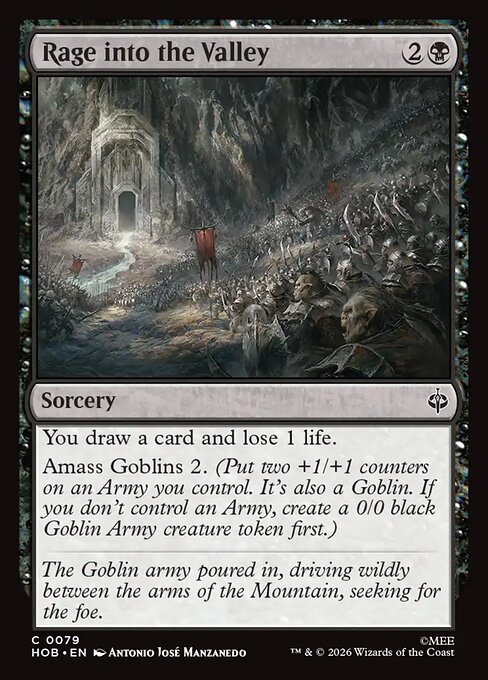
- For three mana, you draw a card, lose 1 life and amass Goblins 2. With no Army in play, you finish with a 2/2 Goblin Army and a card replacing the spell you spent.
- If you already control an Army, you put two counters on an Army instead of creating two new Goblins. That favors a deck building one large Army, while sacrifice decks should not count it as two separate bodies.
- Choose it for the combined body and card in a Goblin, Army or sacrifice plan. For a deck that only wants to draw cards, three mana for one draw is a weak reason to include it.
- Seventh is a modest role-player. Night's Whisper costs two mana, draws two cards and loses 2 life. Choose Whisper for cards in hand; Rage needs the Army, a sacrifice outlet or a relevant spell trigger to justify spending more mana for one draw.
Two casts for spell and Army decks
8. Tidings of War
{R} · HOB 115
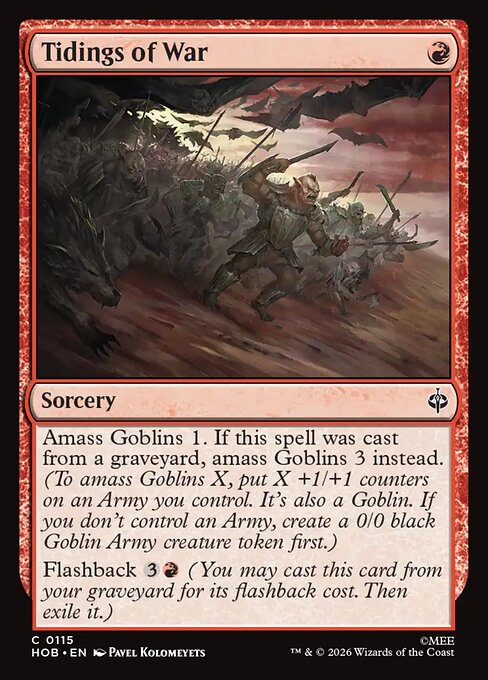
- The first cast costs one red mana and amasses Goblins 1. Flashback costs four mana and amasses 3 instead, giving the same card a useful second casting from the graveyard.
- If your first Army survives, the two casts normally build that one creature from 1/1 to 4/4. They do not produce four separate Goblins. If the first Army dies, the later cast can make a new 3/3.
- Spell-casting triggers and graveyard plans give it a clearer job than a generic go-wide token deck. Across both normal casts you spend five mana, so do not mistake the cheap front half for a cheap second wave.
- Eighth suits repeated spell casts or a growing Army. Dragon Fodder gives two separate Goblin bodies for two mana, which is a better starting point when you need multiple attackers or sacrifices. Tidings offers two casts from one card, with a four-mana second cast, rather than efficient go-wide production.
Creature decks turning size into removal
9. Troll Negotiations
{2}{G}{G} · HOB 138
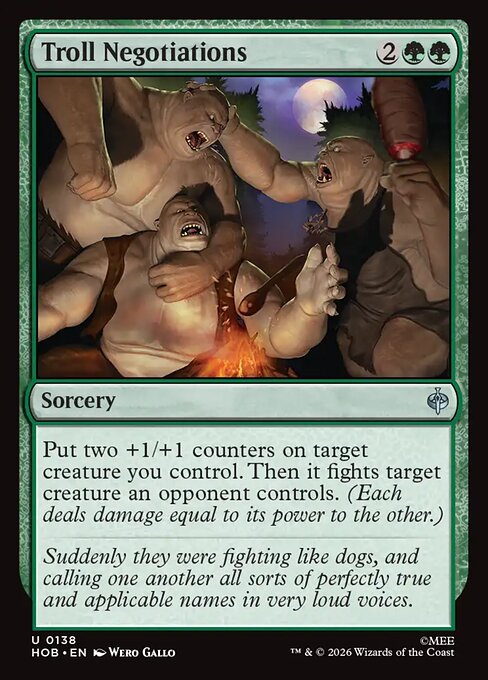
- Put two +1/+1 counters on a creature you control, then have it fight an opponent’s creature. The counters stay even after the turn, which rewards creatures that can survive the exchange.
- Fight deals damage in both directions. A 3/3 becomes a 5/5 before fighting, but it can still die to a larger creature or to deathtouch. This is not damage dealt only to the opponent’s creature.
- You need two legal targets when casting: a creature you control and a creature an opponent controls. If either target becomes illegal before resolution, there is no fight. If only the opposing target becomes illegal, your still-legal creature gets the two counters.
- Ninth asks for an established creature and a safe fight. Bite Down costs two mana, is an instant and makes your creature deal damage without taking return damage from a fight. Troll’s permanent counters can matter in a counter deck, but they need to justify twice the mana and sorcery timing.
Creature recovery with an Army attached
10. Gathering of Darkness
{3}{B} · HOB 68
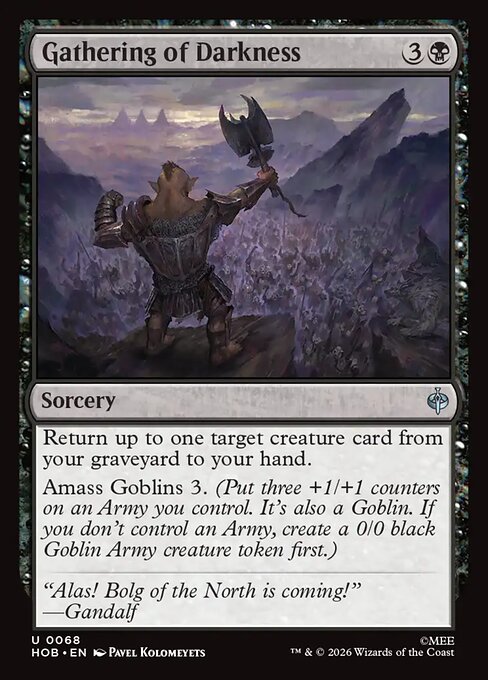
- This gives a slower black creature deck two effects for four mana: recover up to one creature card from your graveyard to your hand, then amass Goblins 3.
- The recovered creature does not enter the battlefield. You must still cast it, so compare the combined cost with a spell that would reanimate it directly if speed is your priority.
- You can choose no creature target and still amass. If you do choose a target and it becomes illegal, the spell has no remaining legal targets and does not resolve. Leave the target off when the Army matters more than a vulnerable graveyard card.
- Tenth combines creature recovery and an Army, but neither half is unusually efficient. Victimize costs three mana and, if you sacrifice a creature on resolution, returns two targeted creatures to the battlefield tapped. Gathering needs no sacrifice and can make its Army without a target; choose it for that combination, not when your main goal is fast reanimation.
Published lists
Best Hobbit Sorceries in Standard
- Stir Up Trouble has the clearest current list evidence in this review. In the October 8, 2026 Magic Online Standard Challenge 16 Special, onlybrews registered three main-deck copies, while pizzangry and Pinnu registered one each.
- That is five main-deck copies across three of the 30 published decks. These are observed inclusions in one event, not a format-wide win rate or proof that the card belongs in every black deck.
- Desolation of Smaug also appeared as one sideboard copy in LegacyGrinder’s list at that event. That supports a narrower matchup option, not the same main-deck use as Stir Up Trouble; registration alone does not show whether it was cast or won a game.
- The one-mana option is most useful when the deck can sacrifice an expendable artifact or creature. Compare the full cost of doing that with the removal your deck already plays.
- Read the complete October 8 Standard lists. The profiles above make broader Commander recommendations; the numbering does not rank these cards by Standard results.
Separate category
Hobbit Sorcery Adventures
- The main set also has thirteen cards with a sorcery Adventure. Those are permanent cards outside the stack, so they are separate from the ten front-face sorceries above.
- The Arkenstone’s Seek the Heart costs two generic and one white mana to search your library for a legendary creature and put it into your hand. You still need to cast that creature, and casting The Arkenstone from exile later normally costs another five mana. Choose it when finding a particular legendary creature is worth those separate costs.
- Glamdring, Foe-hammer’s Gleam of Death costs four mana to mill six cards and put all instant and sorcery cards among them into your hand. It can find several spells in a spell-heavy deck, but can also find none. Rage into the Valley gives you a predictable one-card draw and an Army instead. Other Adventure cards do not qualify just because their Adventures are sorceries.
- An Unexpected Party’s At the Door makes X 2/2 red Dwarfs for X plus three mana. Choose it for Dwarf or creature-type synergies and access to the later enchantment, rather than treating it as an unusually efficient generic token spell.
- An Adventure must resolve to supply its usual permission to cast the permanent from exile later. If it is countered, that permission does not appear. You still pay the permanent’s cost and follow its normal timing rules. Check the whole card’s color identity before adding it to a Commander deck.
Evidence and scope
Hobbit Sorcery Selection and Sources
- Card text, ten front-face sorceries and thirteen sorcery Adventures were checked October 9, 2026 against the main HOB set. HOC Commander cards and alternate printings are outside this count.
- The September 29, 2026 Pauper Challenge’s 24 published lists contained none of the ten front-face sorceries. That small sample does not prove the cards are absent from Pauper; it does not support calling them established Pauper picks either.
- No Modern or Pioneer performance ranking is claimed. Legality alone does not establish tournament use, and Commander recommendations here are judgments about deck fit.
- Wizards’ Hobbit release notes explain the set mechanics and Adventure rules. Each profile links its current card text.
- September 29 Magic Online Pauper lists and the dated Standard lists above provide the tournament sample. Prices are not quoted; shopping buttons identify the pictured regular HOB printing.
- If you need other spell types, compare Hobbit instants and Hobbit artifacts.